MCP Host vs Client vs Server: Differences and Examples
Compare MCP hosts, clients and servers in one diagram. See who coordinates the model, sends requests, executes tools and controls permissions.
Version and test detailsProtocol architecture verified August 25, 2026 against MCP 2026-07-28. Check current product documentation for features and SDK support.
On this page
Version verifiedChecked August 25, 2026 against MCP 2026-07-28. Review method.
Follow one request
Trace responsibility from user intent to a bounded capability without confusing the three logical roles.
- Host owns intentThe host gathers user intent, runs the model-facing experience, controls consent, and presents the result.Read the deep section →
- Client carries MCPA client manages one logical server relationship and carries the host's protocol requests and responses.Read the deep section →
- Server enforces scopeThe server advertises focused capabilities, validates inputs, applies its own authorization, and returns results.Read the deep section →
The host coordinates the AI application, the client carries MCP messages, and the server supplies the capability. Here is how the three roles fit together.
MCP host, client, and server at a glance
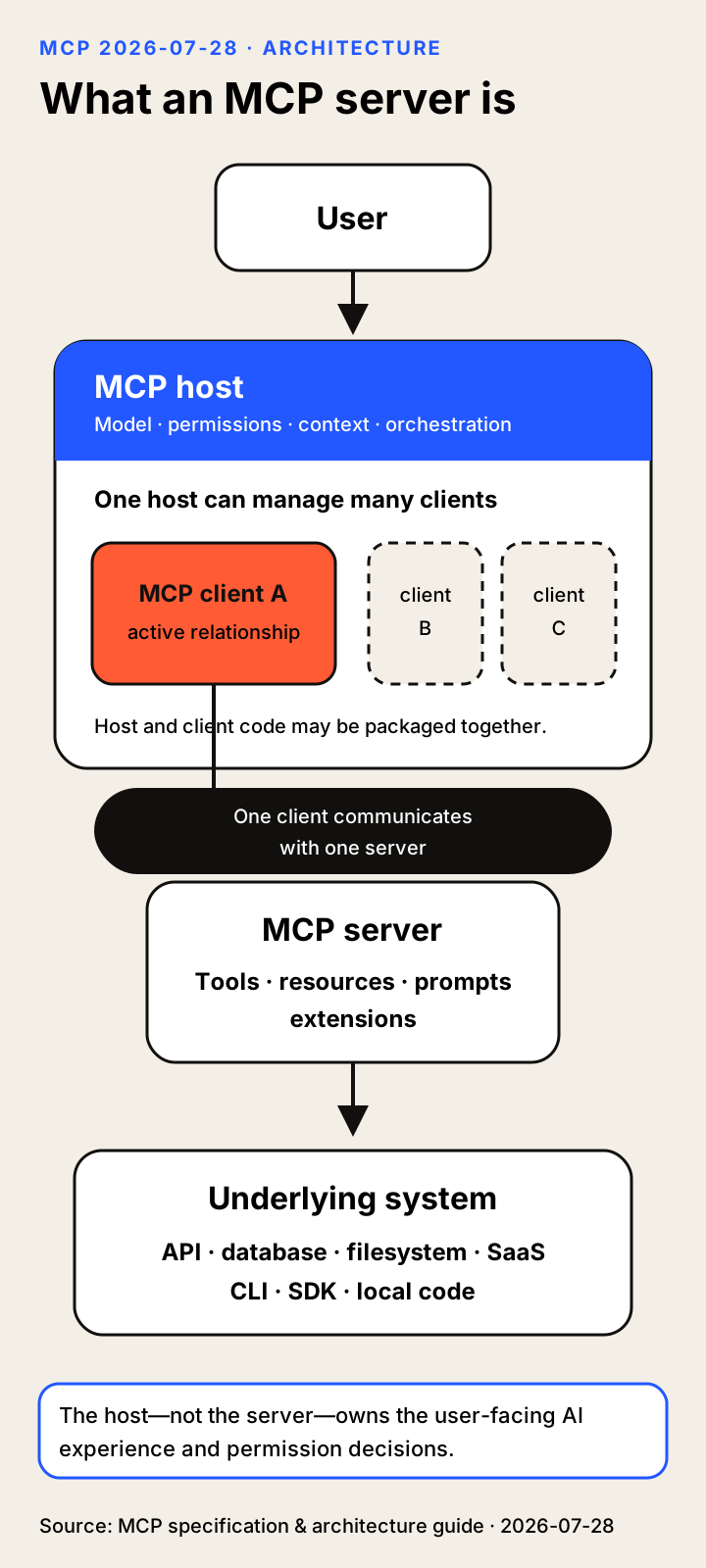
An MCP host is the application coordinating the model, user experience, context, and permissions. An MCP client is the protocol component the host uses to communicate with a particular server. An MCP server exposes capabilities and performs or delegates the requested work.
| Role | Main responsibility | Do not confuse it with |
|---|---|---|
| Host | Coordinate the model, user interface, context, and permission decisions. | The server supplying a tool. |
| Client | Send and receive MCP messages for one logical server relationship. | Necessarily a separate application. |
| Server | Expose capabilities and execute or delegate their implementation. | Necessarily an AI model or agent. |
These are logical roles, not three required machines. One host can contain several clients, each communicating with a different server. MCP architecture.
Example: create an issue in a repository
Suppose a user asks an AI application to create an issue describing a login problem. This is a conceptual example, not a test of a particular product or a claim about its tool names.
| Stage | Responsible component | What happens |
|---|---|---|
| Understand the request | Host and its model integration | The application prepares the information needed for an issue. |
| Apply application policy | Host | It decides whether to allow the attempt and whether to ask for confirmation. |
| Send the request | MCP client | It invokes the selected server capability through MCP. |
| Perform the operation | MCP server and repository system | The server validates the request and asks the repository system to create the issue. |
| Present the result | Client, then host | The result returns to the application, which reports success or explains the failure. |
A host's confirmation does not override repository permissions. The server and underlying system must still reject work the caller is not allowed to perform. MCP authorization.
The practical distinction: the model may propose an action, but the application mediates it. The client carries the request; the server implements the capability.
Protocol scope: this guide distinguishes the 2026-07-28 revision from older implementations. Use the protocol-version comparison for lifecycle and compatibility details.
Host, client, and server roles
What is an MCP host?
An MCP host is the application or service that gives the protocol a user-facing and model-facing purpose. The current specification describes the host as the container and coordinator that creates and manages clients, controls connection permissions and lifecycle, enforces security and consent, handles user authorization decisions, integrates with the AI model, aggregates context, and manages coordination across servers. S121
A host can be:
- a desktop AI application;
- an IDE or coding-agent interface;
- a web application;
- a command-line agent;
- a custom application built with an SDK;
- a cloud API feature that coordinates model and MCP operations;
- an enterprise agent platform or gateway-backed application.
The role is defined by responsibilities rather than branding.
The host owns the user experience
The protocol can describe a tool and carry a tool call, but it does not define one universal confirmation dialog. The host decides whether to:
- show every call;
- automatically approve read-only operations;
- block destructive operations;
- apply an organization allowlist;
- show tool arguments before execution;
- require a second approval after arguments change;
- expose a server’s prompts as slash commands;
- render structured results as a table;
- launch an MCP App in a sandbox;
- hide unsupported capabilities.
This is why “the MCP server asked the user for permission” is usually imprecise. The server can return an authorization challenge, an input_required result, or metadata relevant to an operation. The host owns the interface through which the user sees and responds to that need. S123 S126
The host owns the model loop
MCP is not an LLM and does not mandate a model provider. The host decides:
- which model receives the user’s request;
- which tool definitions are shown to that model;
- how tool schemas are translated into the provider’s format;
- whether resources enter the context window;
- whether a prompt template is offered to the user;
- how many tool-result/model rounds are allowed;
- how errors are summarized;
- when the agent loop terminates.
Microsoft’s description of an agent harness closely matches these host duties: assemble context, invoke a model, interpret structured tool calls, execute or route tools, return results, and repeat. MCP can supply the external capabilities used by that harness, but MCP does not replace the harness. S264
The host owns cross-server orchestration
Suppose a user asks:
Read the production incident in Slack, inspect the related GitHub pull request, query the observability database, and create a follow-up issue.
A host might use four servers:
Slack server       → messages and threads
GitHub server      → repository and issue tools
Database server    → telemetry query
Project server     → issue creation
Each client-server relationship remains isolated. The host is the component that can combine outputs, decide whether one server’s result should be sent to another, and maintain the overall plan. That design limits what a compromised server can learn by default.
The host owns the complete conversation
The current architecture explicitly places full conversation retention in the host. Servers receive only necessary context. This is both a privacy boundary and a practical design rule. S121
A tool call may contain:
{
  "name": "create_issue",
  "arguments": {
    "repository": "example/project",
    "title": "Investigate timeout regression",
    "body": "Summary derived by the host..."
  }
}
The GitHub server does not need every earlier user message, every output from the database server, or the model’s hidden reasoning. The host can send a concise body assembled from those sources.
Host responsibilities are not fully standardized
The protocol standardizes the wire boundary, not the entire product. It does not force every host to support:
- every server capability;
- every client-side capability;
- every extension;
- identical permission prompts;
- identical context limits;
- identical schema conversion;
- identical server installation methods;
- identical OAuth behavior;
- identical error recovery.
This is why interoperability is real but bounded.
What is an MCP client?
An MCP client is the protocol-speaking component created by a host for a particular server. The current architecture describes each client as communicating with exactly one server, attaching protocol version and client capabilities to every request, routing messages, managing subscriptions and notifications, and maintaining isolation from other servers. S121
The client is not necessarily visible to the user. It may be:
- an object inside a desktop application;
- a service inside a cloud product;
- a library object in a developer’s process;
- an internal component that launches a local subprocess;
- a hosted connector operated by a model provider;
- an adapter behind an enterprise gateway.
A client handles protocol mechanics
Typical client-side work includes:
- Locating or launching the server.
- Selecting stdio or Streamable HTTP.
- Constructing valid JSON-RPC requests.
- Adding current protocol metadata.
- Optionally calling
server/discover. - Listing tools, resources or prompts.
- Parsing server results and errors.
- Managing subscribed notification streams.
- Retrying according to operation and transport semantics.
- Reporting results to the host.
An SDK can hide much of this work. The role remains the same even when a developer uses one high-level method.
A current client carries version and capabilities per request
Under 2026-07-28, modern requests are self-describing. The client carries:
- the protocol version;
- client implementation information;
- client capabilities relevant to the request.
The server validates the version and can return an unsupported-version error. The client may call server/discover first to obtain supported versions, server identity metadata and capabilities. server/discover is required for current servers but optional for clients; a client can attempt a request directly and handle a version error. S056 S127
This replaces the old model:
Open connection
   ↓
initialize
   ↓
negotiate version and capabilities
   ↓
initialized notification
   ↓
use session state for later messages
with a model closer to:
Optional server/discover
   ↓
Send a self-describing request
   ↓
Receive an independent response
One client to one server is a logical relationship
The phrase “one client connects to one server” remains useful, but it must be interpreted carefully.
It does not mean:
- one host can use only one server;
- one client equals one TCP connection;
- one client requires one persistent protocol session;
- one server equals one process;
- one remote server can serve only one client;
- each request must reach the same replica.
It means that an MCP client instance or logical client relationship is scoped to one server. That supports:
- capability isolation;
- server-specific credentials;
- server-specific errors and retries;
- independent transport configuration;
- permission and tool-name scoping;
- easier revocation;
- reduced cross-server leakage.
A host with ten servers generally has ten logical client relationships, even if its networking stack pools HTTP connections or a gateway multiplexes traffic.
The client does not own the complete application policy
A low-level client library may expose hooks for approval, authorization or validation. The host still determines the policy. The client cannot know by itself:
- whether the user intended a destructive operation;
- whether two server results may be combined;
- which model should receive a tool schema;
- whether a tool should be hidden due to enterprise policy;
- how a result should be rendered;
- when the agent should stop.
Those are host decisions.
The client can exist without an LLM
A program can invoke MCP methods directly:
Scheduled process
   ↓
MCP client
   ↓
resources/read
   ↓
Store result in an index
No model is required. The client/server protocol remains valid because MCP is an application integration protocol, not a model execution engine. The “model” in Model Context Protocol describes the target ecosystem and use case, not a mandatory wire participant.
What is an MCP server?
An MCP server is a program or network service implementing the server side of MCP. It exposes a focused set of capabilities to compatible clients. Those capabilities may include tools, resources, prompts, or extensions. S121 S123 S124 S125
A server can wrap:
- a REST or GraphQL API;
- a relational or vector database;
- a local filesystem;
- a Git repository;
- an IDE;
- a command-line program;
- a SaaS platform;
- a search engine;
- a proprietary SDK;
- a long-running workflow system;
- local application functionality.
MCP does not prescribe the backend.
The server publishes capabilities
The server controls what it exposes. For tools, it supplies names, descriptions and input schemas, and may supply output schemas and annotations. For resources, it exposes URI-addressed data and templates. For prompts, it exposes templates a host may surface to a user. S123 S124 S125
The client discovers these definitions; the host decides which to use.
The server executes or delegates operations
When a client sends tools/call, the server:
- authenticates and authorizes the request as required;
- validates the arguments;
- maps the call to local code or an underlying system;
- handles backend errors;
- returns an MCP result.
The client transports the request. The server owns the operation’s implementation and should enforce business authorization rather than assuming the host’s confirmation is enough.
The server is not automatically an agent
A server may expose one simple deterministic tool:
convert_temperature(celsius) → fahrenheit
It may expose a complex long-running research workflow. It may internally use an LLM. None of those facts changes its protocol role.
An agent is usually an application loop that plans, selects actions, interprets results and continues until a goal or stopping condition. An MCP server can be used by an agent or expose agentic work, but “server” and “agent” are not synonyms.
The server does not own the host’s model
Launch-era MCP included server-initiated sampling so a server could ask the client/host to perform model inference without the server holding model credentials. Current MCP deprecates the older sampling primitive and moves interactive needs into newer patterns and extensions, but the underlying architectural principle remains: model execution belongs under host/client control unless an application explicitly delegates otherwise. S055 S126
A logical server may be many replicas
Current remote MCP is designed to work behind ordinary HTTP infrastructure:
MCP client
    ↓
Gateway / load balancer
    ├─ Server replica 1
    ├─ Server replica 2
    └─ Server replica 3
Because the protocol core no longer depends on a hidden session, successive requests can reach different instances. Application state can remain in a database or be represented by explicit, authorized handles. S055 S123 S058 S061
Host, client and server compared
The MCP server cornerstone goes deeper on server implementation, examples, installation, and deployment.
| Question | Host | Client | Server |
|---|---|---|---|
| What is it? | User/model-facing coordinator | Protocol component for one server | Capability provider |
| Does it own the UI? | Yes | No independent requirement | Usually no |
| Does it own the model loop? | Yes | No | No protocol requirement |
| Can it coordinate several servers? | Yes | No | No |
| Does it construct MCP requests? | Through its client subsystem | Yes | Receives them |
| Does it publish tools/resources/prompts? | Curates them | Discovers them | Yes |
Does it execute tools/call effects? |
Approves/routes | Sends | Executes/delegates |
| Does it keep the full conversation? | Yes | Only necessary protocol state | Only receives what is sent |
| Does it choose confirmation policy? | Yes | Implements mechanics | May enforce additional authorization |
| Does it validate backend permissions? | May precheck | Carries identity | Must enforce or preserve them |
| Can it be local or remote? | Yes | Yes | Yes |
| Is it an LLM? | No, but integrates one | No | No |
| Is it automatically an agent? | May contain an agent loop | No | No |
| How many? | One host may manage many clients | One logical server per client | One server may serve many clients |
The complete research package includes a thirty-row responsibility matrix because many important duties—credential storage, tenant isolation, notification subscriptions, MCP Apps, explicit state handles, and observability—cannot be represented in a small table.
Where does the LLM sit?
The MCP vs function calling comparison follows the translation between provider-native model tool calls and MCP methods.
The model normally sits behind or inside the host’s model integration layer:
User
  ↓
Host UI and agent loop
  ↔ Model provider / local model
  ↓
MCP client
  ↓
MCP server
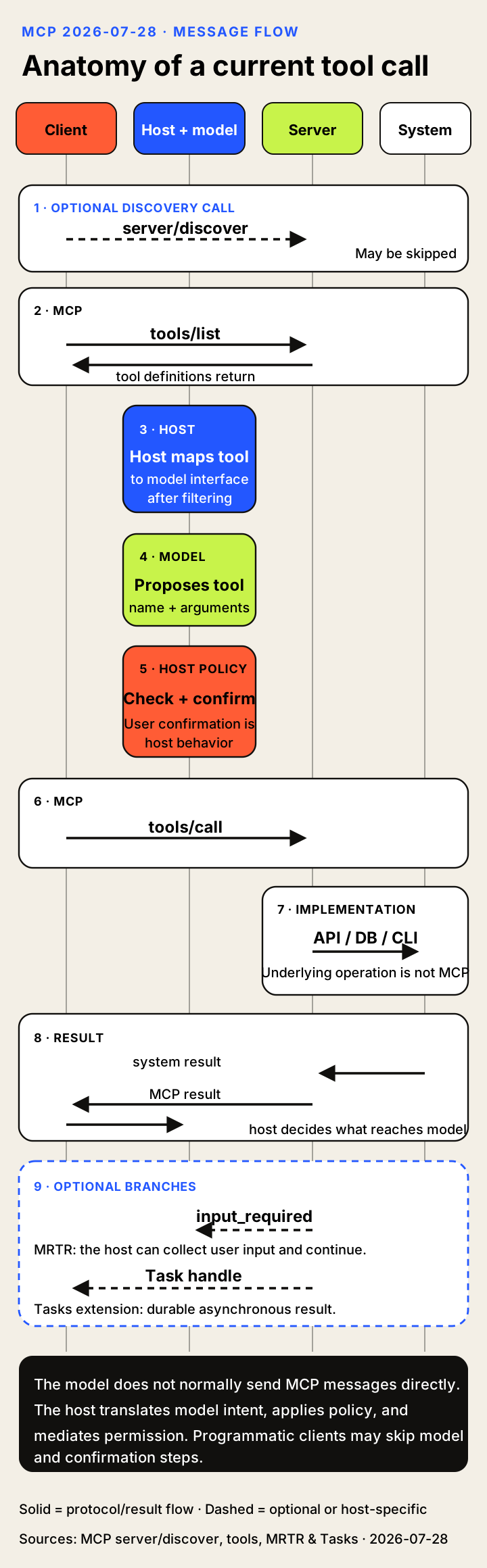
The model may produce a structured tool call, but the host interprets that output. The host may map an MCP tool definition into OpenAI, Anthropic, Gemini, or another model provider’s native tool format. After the model selects a tool, the host invokes tools/call through the appropriate MCP client. S123 S090 S264
This produces a layered sequence:
1. MCP client discovers `create_issue`.
2. Host filters and converts its schema.
3. Host presents the tool to the model.
4. Model returns a provider-specific tool call.
5. Host checks policy and asks for confirmation if required.
6. Client sends MCP `tools/call`.
7. Server invokes the source-control API.
8. Client receives the MCP result.
9. Host converts the result for the model and user.
The model does not need to know whether the capability came from:
- a direct application function;
- an MCP server;
- a provider-hosted tool;
- an internal service;
- a gateway-generated adapter.
The host owns that abstraction.
Can a server call a model?
A server implementation can call any API its operator permits, including a model API. That is an implementation choice, not a built-in identity. Historically, MCP also gave servers a protocol mechanism to request sampling through the client. Current architecture changes and deprecations mean that any statement about server-to-client sampling must name the specification revision. S249 S251 S055
Can MCP work without a model?
Yes. A client can programmatically list tools, read resources, invoke tools, or monitor subscribed notifications. The protocol is useful as a structured application boundary even when deterministic software—not an LLM—chooses every method.
Architecture by protocol era
The launch-era architecture: 2024–2025
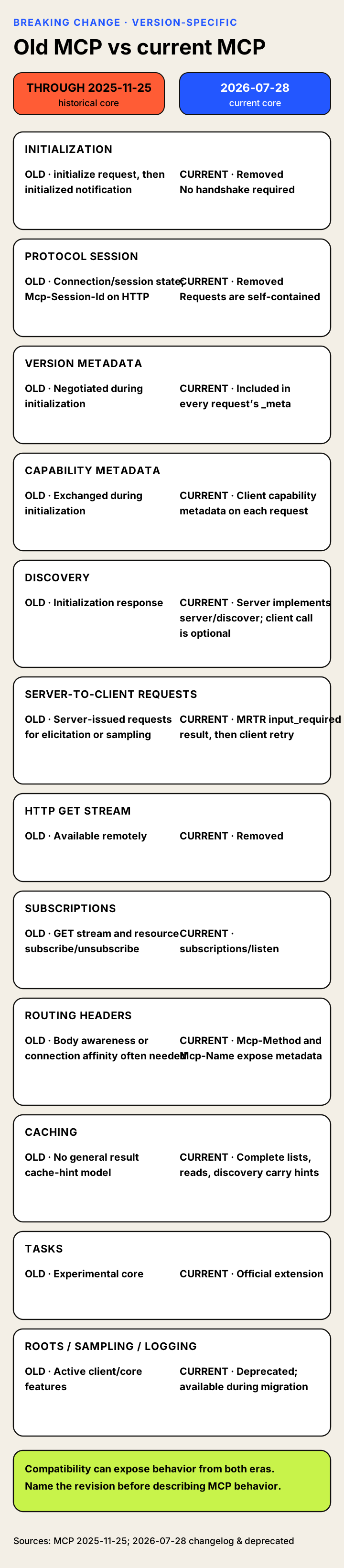
Use the MCP protocol versions guide to compare compatibility behavior and the primary-source MCP history to place each architecture claim in its released protocol era.
The host–client–server roles were present in the first public specification. The early architecture described:
- hosts as LLM applications;
- clients as connectors within hosts;
- servers as services providing context and capabilities;
- one stateful client/server session;
- version and capability negotiation during initialization;
- bidirectional JSON-RPC requests;
- stdio and HTTP+SSE transports. S249 S026 S250
The lifecycle was central:
Client connects
   ↓
Client sends initialize
   ↓
Server selects protocol version and returns capabilities
   ↓
Client sends notifications/initialized
   ↓
Normal operation begins
The connection carried negotiated state. A server could know what the client had declared during initialization. Later messages did not need to repeat all of that data.
Why old documentation calls the client a session manager
That wording was accurate for the legacy era. The 2025 architecture said each client maintained a stateful session with one server. Streamable HTTP replaced the original two-endpoint HTTP+SSE transport in March 2025, but the new transport initially kept initialization and optional session identifiers. S156 S251 S036
The protocol changed in layers:
November 2024
- stateful initialization;
- stdio and HTTP+SSE;
- tools, resources and prompts;
- direct server-to-client requests such as sampling.
March 2025
- Streamable HTTP;
- OAuth authorization framework;
- still initialized and stateful;
- direct server-to-client requests retained.
June 2025
- structured tool output;
- elicitation;
- authorization hardening;
- still initialized and stateful.
November 2025
- expanded authorization and elicitation;
- experimental Tasks;
- last released handshake/session architecture.
A page written in 2025 is not necessarily “wrong” when it says clients negotiate capabilities during initialize. It becomes wrong when that description is silently presented as the only current architecture after July 28, 2026.
The current architecture: 2026-07-28
The 2026-07-28 release guide and stateful-to-stateless migration guide cover the current wire rules and compatibility boundary.
The 2026-07-28 revision made the largest architectural change since launch. It removed:
initialize;notifications/initialized;- protocol-level sessions;
Mcp-Session-Id;- the assumption that future requests must reach a process holding negotiated state. S055 S058
It added or formalized:
- version and client capabilities on every request;
server/discover;- explicit result types;
- Multi Round-Trip Requests;
- header-based routing;
- cacheable list results;
- explicit subscription streams;
- an extensions framework. S055 S127
Current request flow
A modern client can begin with discovery:
Client → server/discover
Server → supported versions, capabilities, identity metadata
It then sends a request containing current metadata:
{
  "jsonrpc": "2.0",
  "id": 1,
  "method": "tools/list",
  "params": {
    "_meta": {
      "protocolVersion": "2026-07-28",
      "clientInfo": {
        "name": "example-host",
        "version": "1.0.0"
      },
      "clientCapabilities": {}
    }
  }
}
The exact schema should be taken from the released specification, not copied from this simplified teaching example. The architectural point is that the request carries the information the server needs rather than depending on an earlier handshake. S056 S127
server/discover does not create a session
Discovery reports what the server says it supports. It does not establish hidden connection state. A later request is still self-describing.
The server’s identity metadata is also self-reported; it is useful for user interfaces and diagnostics but should not be treated as a cryptographic publisher certificate. S127
MRTR replaces ordinary server-initiated requests
Earlier MCP allowed the server to send a JSON-RPC request back to the client during an active session. That pattern was difficult to route through stateless HTTP infrastructure.
Current Multi Round-Trip Requests use a result such as input_required. The client/host obtains the needed input, then retries the outer request with explicit request state and input responses. S055 S123 S126
Conceptually:
Client → tools/call
Server → input_required: ask user for project ID
Host   → shows elicitation UI
Client → retries tools/call with project ID and request state
Server → complete result
The host remains in control of the user interaction. The server remains in control of its operation. The client transports the rounds.
Stateless does not mean memoryless
A server can maintain:
- durable database records;
- a background job;
- a Task;
- authorization state;
- a cache;
- an external workflow;
- an explicit server-generated handle.
The current tools specification describes the explicit-handle pattern. The server returns a handle, and the host/model includes it in later calls. The server must bind that handle to the correct user and authorization context. S123
The difference is:
Legacy: hidden state associated with protocol session
Current: explicit request data or application-managed durable state
Did the 2026 revision eliminate the client–server relationship?
No.
Stateless protocols still have clients and servers. HTTP itself is the clearest example. A client sends a request; a server processes it. Removing a handshake changes how the parties establish compatibility and carry state, not which party initiates an MCP method or exposes a capability.
Current MCP still defines:
- client requests;
- server responses;
- client capabilities;
- server capabilities;
- client-side features;
- server-side primitives;
- one client’s logical relationship to a particular server;
- host management of multiple clients. S121 S130
The revision eliminated a protocol session, not the client role.
Does one MCP client still connect to one server?
The current architecture still describes a one-to-one client/server relationship. The correct interpretation is logical, not necessarily physical. S121
Logical relationship
The client keeps one server’s:
- endpoint or process configuration;
- capabilities;
- identity metadata;
- credentials;
- tool/resource/prompt namespace;
- errors and retry context;
- notification subscriptions.
Physical deployment
The same logical server might be:
one local subprocess
or:
one URL → gateway → many replicas
The client’s HTTP stack might:
- open a fresh connection;
- reuse a keep-alive connection;
- multiplex requests over HTTP/2;
- route through a corporate proxy;
- receive an SSE response stream for one request.
None of those transport details changes the logical role.
Why maintain one client per server?
Isolation reduces accidental coupling. If two servers expose a tool named search, the host can scope names by server. If one server is revoked, its client relationship can be closed without affecting others. Credentials stay server-specific. A malformed response is attributed to one boundary.
The current tool specification recognizes that name collisions are possible across servers and leaves disambiguation to clients, proxies, or hosts. S123
Local, remote, and multi-server topology
Local MCP architecture
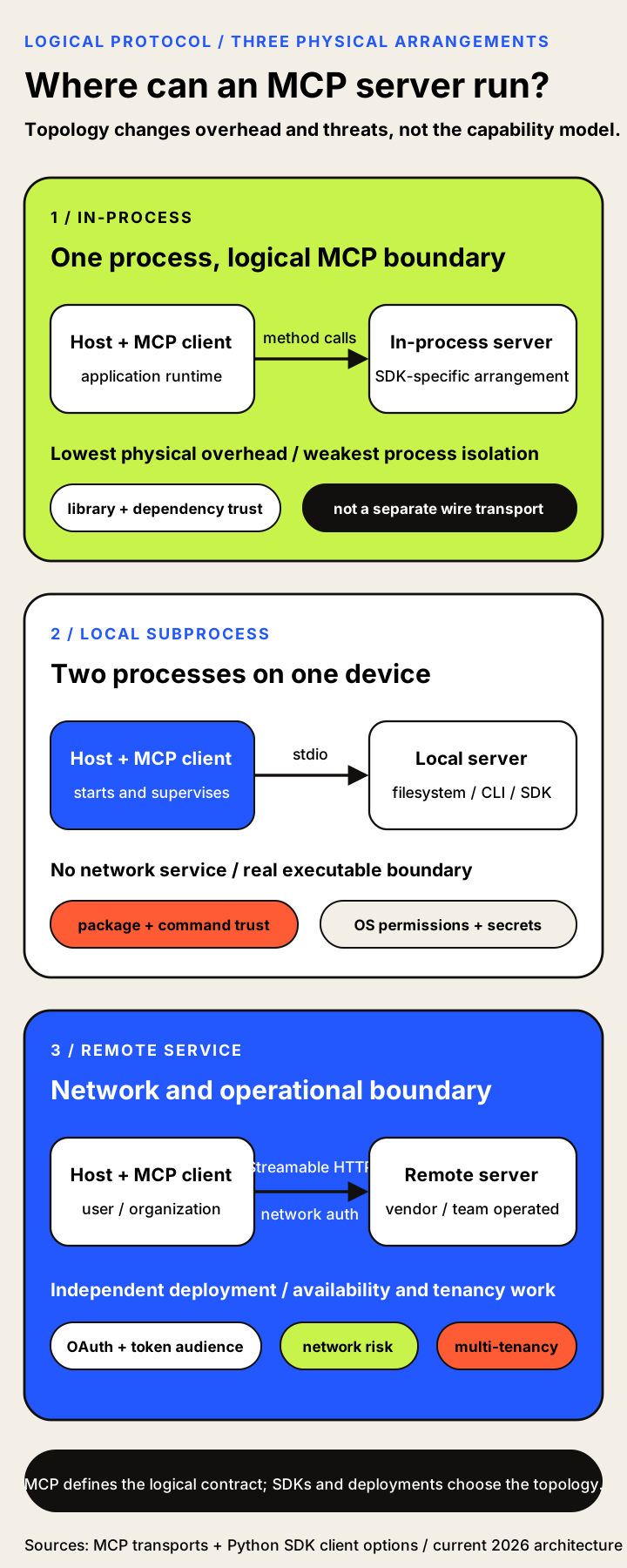
The MCP transport guide compares stdio, current Streamable HTTP, and the two legacy HTTP eras. The local vs remote MCP deployment guide covers location, authority, security, cost, hosting, and hybrid decisions.
The most familiar local pattern is:
Host application
    ↓ creates client
Client launches subprocess
    ↓ writes JSON-RPC to stdin
Local MCP server
    ↓ writes JSON-RPC to stdout
Client returns result to host
The current stdio specification says the client launches the server as a subprocess, writes messages to stdin, reads messages from stdout, and treats stderr separately for logging. Messages are newline-delimited JSON-RPC. S132
What the host does locally
The host determines:
- which configuration is trusted;
- what command and arguments may run;
- what directories the server can access;
- which environment variables are inherited;
- whether packages may be downloaded automatically;
- whether a project may define server configuration;
- whether the process runs in a sandbox;
- which tools are exposed to the model.
Zed’s current worktree-trust rules illustrate that this is a host security responsibility: Restricted Mode prevents project-configured language and MCP servers from being downloaded or started until the worktree is trusted. Globally configured servers are outside that worktree-trust gate. S272
What the client does locally
The client:
- starts the exact process;
- maintains stdin/stdout framing;
- separates logs from protocol output;
- detects process exit;
- terminates or restarts according to host policy;
- reports startup failures;
- sends modern or legacy protocol messages according to compatibility mode.
What the server does locally
The server:
- runs with the permissions of its process identity;
- validates paths and commands;
- constrains filesystem roots;
- avoids writing logs to stdout;
- returns protocol errors rather than crashing where possible;
- protects local secrets and external credentials.
Local does not mean harmless. A local server package is executable code.
Remote MCP architecture
A current remote deployment may look like:
Host
  ↓
MCP client
  ↓ HTTPS
Enterprise gateway / load balancer
  ↓
Logical MCP server
  ├─ Replica A
  ├─ Replica B
  └─ Replica C
       ↓
SaaS API / database / internal service
The client sends each MCP request to the Streamable HTTP endpoint. The server may return an ordinary JSON result or a request-scoped SSE stream. Current MCP removed the old general GET stream and protocol sessions. S131
The host’s remote responsibilities
The host manages:
- approved endpoint policy;
- account connection and consent;
- credential storage;
- user-facing server identity;
- tool allowlists;
- confirmation policy;
- organization restrictions;
- context sent off-device;
- result handling.
The client’s remote responsibilities
The client manages:
- HTTP request formation;
- protocol metadata;
- authorization flow mechanics;
- TLS and redirect behavior through its HTTP stack;
- streaming response handling;
- retry and timeout behavior;
- server discovery and version errors;
- subscribed notification streams.
The server’s remote responsibilities
The server manages:
- token validation;
- user and tenant authorization;
- resource ownership;
- rate limits;
- backend credentials;
- horizontal scaling;
- observability;
- safe explicit state handles;
- cache scope;
- errors that do not leak sensitive information.
A gateway is not a fourth core MCP role
Gateways, reverse proxies, aggregators and policy layers are ecosystem deployment roles. A gateway may terminate authorization, route requests, rewrite names, combine catalogs, or enforce policy. The core protocol still sees client and server behavior on each side of that intermediary.
Marketing terms should not be projected into the specification. “MCP gateway” is useful operational vocabulary, but it is not equivalent to host, client or server.
One host using multiple servers
Consider a coding host with three servers:
Host
 ├─ Client: filesystem
 ├─ Client: GitHub
 └─ Client: database
At startup or discovery time, the host obtains:
filesystem:
  read_file
  write_file

GitHub:
  search_code
  create_issue

database:
  list_tables
  query_readonly
The host may:
- Prefix or group names to avoid collisions.
- Hide
write_filein read-only mode. - expose
query_readonlyonly for approved projects; - defer loading rarely used tool schemas;
- show only five tools to the model for a particular request;
- require confirmation for
create_issue; - keep database results out of the GitHub server unless required.
The client objects do not jointly plan this. The host does.
Cross-server trust
A compromised database server might return text instructing the model to call write_file with sensitive data. The host is the only component positioned to recognize that the returned content is untrusted, apply prompt-injection defenses, restrict cross-server actions, and require confirmation.
Server isolation reduces exposure, but the host’s model loop can still create cross-server effects. Architecture and security are inseparable here.
The same server used by different hosts
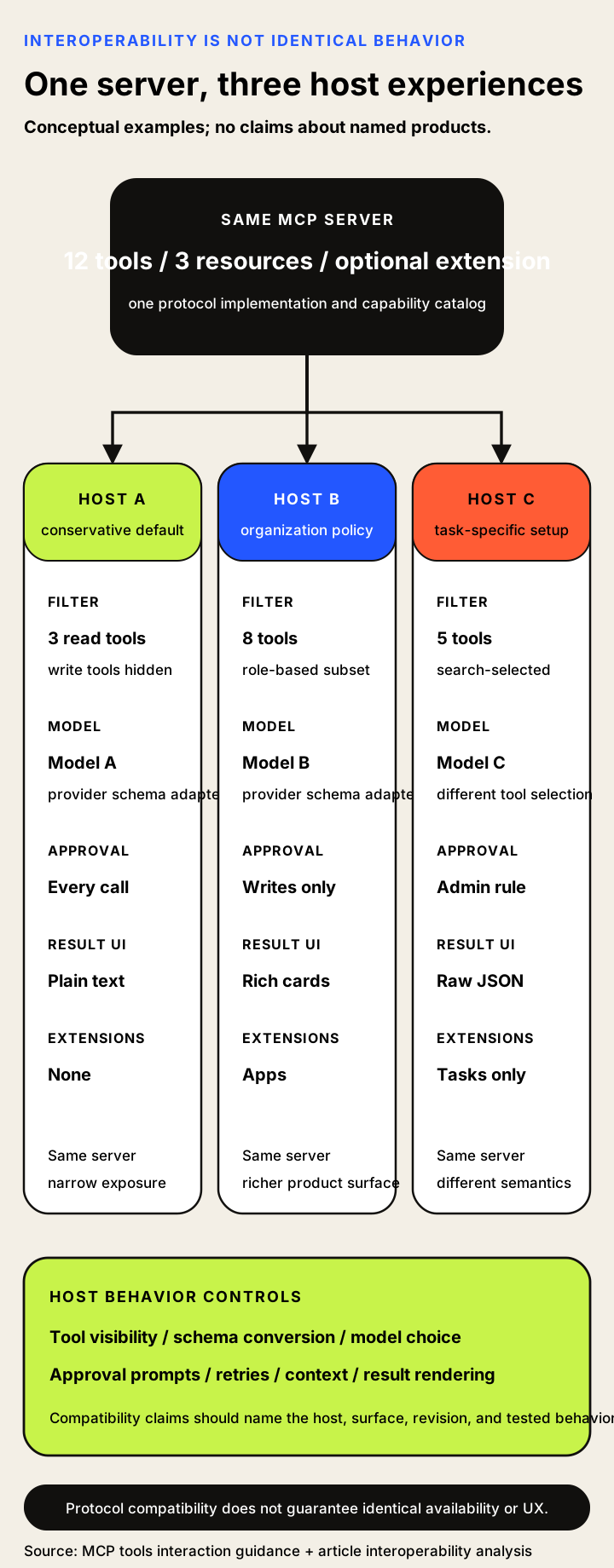
Suppose the same GitHub MCP server is configured in:
- Claude Code;
- ChatGPT;
- VS Code;
- Cursor;
- Gemini CLI.
Protocol compatibility may allow all five to list and call tools. Their behavior can still differ.
| Host behavior | Possible differences |
|---|---|
| Model | Different providers, versions and tool-selection quality |
| Tool catalog | Full list, filtered list, lazy loading or search |
| Naming | Original names or server-prefixed names |
| Confirmation | Every call, destructive calls only, policy-based, or autonomous |
| Resources/prompts | Supported, partially supported or ignored |
| Apps/extensions | Supported only in selected hosts |
| Authorization | Browser OAuth, enterprise-managed flow, static token or unsupported |
| Context | Different conversation, repository and workspace data |
| Error recovery | Retry, model-visible error, user prompt or immediate failure |
| Rendering | Plain text, structured cards, IDE edits or sandboxed UI |
| Legacy support | Modern only, dual-era, or product-specific compatibility |
Wire compatibility guarantees neither identical user experience nor identical security posture.
Current product role classification
The maintained host compatibility matrix tracks documented product behavior separately from these durable role definitions.
Product names often conceal bundled roles. The following classifications were rechecked against current first-party documentation on August 25, 2026. Check the linked documentation before setup because apps, plans and connection options can change independently of the protocol.
Anthropic
Claude Desktop
When MCP functionality is configured, Claude Desktop is a host containing MCP clients. Desktop extensions connect to local, on-device MCP servers; remote connectors use Anthropic-managed cloud connection infrastructure. Those are distinct mechanisms. No general MCP server role is documented for the Claude Desktop surface. S258 S260 S145
Claude Code
Claude Code is a host and client when it uses external servers. Current documentation covers local stdio plus remote Streamable HTTP, deprecated SSE, and WebSocket connections. The separate claude mcp serve command can expose Claude Code capabilities as an MCP server to another client, so one product implements different roles in different relationships. S259
Claude remote connectors
When a remote connector is enabled, the Claude surface—web, mobile, Cowork, Desktop, or Claude Code—is the user-facing host, while the MCP connection originates from Anthropic cloud infrastructure. Local Claude Desktop extensions remain a separate on-device mechanism. S258 S145
Messages API MCP connector
For the beta Messages API connector, the developer application remains the application-level orchestrator. Anthropic’s managed connector uses tools from public HTTPS remote MCP servers over Streamable HTTP or legacy SSE. It does not directly support local stdio, MCP prompts, or MCP resources, and the connector is not itself the connected server. S175
OpenAI
ChatGPT
When an MCP app is enabled in a supported ChatGPT web product mode, ChatGPT is the user/model host and OpenAI-managed infrastructure performs remote MCP client behavior. Full write or modify MCP is beta for Business, Enterprise, and Edu; Pro developer mode supports read and fetch. ChatGPT does not connect directly to local MCP servers; supported private, on-premises, or developer-machine servers use Secure MCP Tunnel. ChatGPT is not the connected MCP server. S140 S262
OpenAI Agents SDK
In an OpenAI Agents SDK application, the developer’s running application is the host. HostedMCPTool or SDK MCP connection classes provide client behavior, and MCPServerManager can coordinate several configured servers. The cited MCP integration documents no built-in MCP server role; an application may implement one separately. S090
Microsoft and GitHub
VS Code
In MCP role terminology, VS Code’s agent experience is a host containing clients for configured local and remote servers. Current documentation covers tools, resources, prompts, and MCP Apps alongside product-specific trust, sandbox, and enterprise policy. The MCP Apps guide explains that optional rendering layer and its current Experimental setting label. Microsoft’s separately named Agent Host is an AHP runtime or process; an MCP relationship can run in the extension host or Agent Host without changing VS Code’s MCP host role. S141 S088
GitHub Copilot cloud agent
GitHub Copilot cloud agent—formerly Copilot coding agent—is the hosted host/orchestrator when MCP is configured and uses MCP client behavior for configured servers. Cloud agent and code review support MCP tools but not resources or prompts; remote OAuth servers are unsupported, and configured tools may run without per-call approval. Those are product limits, not universal protocol limits. S265 S266
Copilot Chat and CLI
Each is a host with client functionality. A preconfigured GitHub MCP server is a distinct server component, even when the user experiences it as part of one product. S267 S268
Gemini CLI is a command-line host and MCP client. Official codelabs show it configuring local and remote servers, requesting permission before tool use, and connecting to Google-hosted MCP services. S144 S271
Cursor
Cursor IDE/Agent Window and Cursor CLI are distinct MCP host surfaces that share configuration and consume configured servers. Current Cursor documentation also explicitly lists the MCP Apps extension as supported for interactive UI views. Neither surface is thereby the configured server, and this classification does not generalize to Cursor Cloud Agents. S269
Zed
Zed is a host and client platform. Current MCP documentation, worktree trust, and mcp:<server>:<tool> permissions show host responsibilities clearly. Restricted Mode gates project-configured language and MCP servers until worktree trust; globally configured servers are outside that gate. Per-tool allow, deny, and confirm rules remain host policy. S272 S273 S284 S285
JetBrains
JetBrains illustrates why roles must be classified by enabled component:
- AI Assistant, when its MCP integration is enabled, acts as a host/client connecting to external servers.
- The separate IDE MCP Server exposes IDE tools to external clients and can supply SSE, stdio, or HTTP Stream configuration.
- The host can pass configured MCP tools to several integrated agents. S274 S275 S276 S277
When AI Assistant and the integrated MCP Server are enabled, the suite can consume MCP servers and separately expose IDE tools without collapsing the roles.
Capabilities, primitives, and permissions
Capability negotiation: legacy and current
“Capability negotiation” means different things in different revisions.
Legacy negotiation
During initialize, the client and server exchanged:
- protocol version;
- client capabilities;
- server capabilities;
- implementation information.
The selected state applied to the session. S026 S156 S160
Current per-request capabilities
Modern requests carry client capabilities relevant to the request. The server uses those declarations to decide what behavior is permitted. The client can use server/discover to inspect server support first. S121 S056 S127
This is not merely a field relocation. It changes infrastructure properties:
- no sticky routing required by MCP core;
- no session store required for negotiated capabilities;
- requests can be inspected independently;
- gateways can route using request metadata;
- horizontal scaling is simpler;
- capability changes can be represented per request.
Capability declaration is not implementation proof
A client declaring a capability says it supports the corresponding behavior. A server describing a capability says it exposes that behavior. Bugs, partial support and product restrictions can still exist.
Interoperability testing must exercise behavior, not merely inspect declarations.
Tools, resources and prompts by role
Tools
Server:
- lists tool definitions;
- validates and executes calls;
- returns results.
Client:
- requests the list;
- invokes a named tool;
- transports results and errors.
Host:
- decides which tools are visible;
- converts schemas for the model;
- obtains confirmation;
- interprets results.
Model:
- may select a tool through provider-specific function calling.
Resources
Server:
- publishes URI-addressed resources and templates;
- reads resource contents;
- emits subscribed changes where supported.
Client:
- lists and reads resources;
- maintains subscriptions.
Host:
- decides whether and how resource content enters context;
- labels provenance;
- applies size and trust controls;
- renders attachments or references.
A tool result is not automatically a resource.
Prompts
Server:
- publishes named prompt templates and arguments.
Client:
- lists and retrieves them.
Host:
- surfaces them as commands, forms or templates;
- chooses whether they become user messages, context or workflow inputs.
An MCP prompt is not the host’s system prompt.
Permissions and responsibility boundaries
The MCP security guide expands these role boundaries into a layered threat model and operational controls.
The host’s confirmation and the server’s authorization answer different questions.
Host confirmation
Does the user intend for this model-driven application to attempt this action now?
Server authorization
Is this caller allowed to perform this action on this object under current credentials and policy?
Both may be required.
A user can confirm “delete file,” but the server must still reject a path outside its approved root. A host can approve “create issue,” but the server or GitHub API must still reject a repository the user cannot access.
Tool annotations are not permissions
MCP tool annotations can describe properties such as read-only or destructive. The specification says clients must treat annotations as untrusted unless the server itself is trusted. They help a host design policy; they do not enforce the effect. S123
The host cannot outsource semantic safety to JSON Schema
Schema validation can prove that path is a string. It cannot prove that the path is inside an authorized directory. It can prove that amount is a number. It cannot prove that a payment is legitimate.
Server-side semantic and business authorization remains essential.
MCP without an LLM
A deterministic program can use MCP as a reusable integration layer.
Example:
Nightly indexer
  ↓
MCP client A → documentation server → resources/list + resources/read
  ↓
MCP client B → GitHub server → search tool
  ↓
Index database
The program—not a model—chooses every method. This demonstrates:
- the host can be a service rather than a chat application;
- MCP clients are ordinary protocol components;
- tools can be called programmatically;
- the “model” is not a wire-level participant.
MCP’s strongest adoption story may remain AI applications, but its architecture is not technically limited to stochastic model selection.
Debugging MCP by responsibility
When an integration fails, start with the role boundary.
Host symptoms
- Tool never appears to the model.
- Confirmation UI is wrong.
- Result is rendered poorly.
- Cross-server context leaks.
- Product ignores prompts or resources.
- Unsupported extension is silently dropped.
Investigate:
- host filters and policy;
- model tool limits;
- schema translation;
- user/workspace settings;
- extension support;
- context construction.
Client symptoms
- Server cannot be launched.
- JSON-RPC framing is invalid.
- Version mismatch occurs.
- HTTP authorization never completes.
- SSE response is parsed incorrectly.
- Subscription drops.
- Retry duplicates an effect.
Investigate:
- transport;
- protocol metadata;
- compatibility mode;
- SDK version;
- timeout and retry behavior;
- credential configuration;
- stdout contamination.
Server symptoms
- Tool list is wrong.
- Call arguments pass schema validation but cause unsafe effects.
- Authorization is bypassed.
- Wrong tenant data appears.
- Explicit handle can be guessed or reused.
- Backend error leaks secrets.
- Tool description is inaccurate.
Investigate:
- server implementation;
- backend mapping;
- semantic validation;
- token binding;
- tenant context;
- state-handle design;
- error sanitization.
Underlying-system symptoms
- Native API rejects the operation.
- Database permission differs from host expectation.
- Rate limit is exceeded.
- Eventual consistency delays results.
- Service account is overprivileged.
MCP does not erase the backend’s own behavior.
Mistakes, recommendations, and myths
Common architecture mistakes
“The MCP server contains the model”
No. A server may use a model internally, but MCP does not require that. The model normally runs through the host.
“The MCP client is always the app users open”
The app is usually the host. It contains multiple clients.
“One client connects to every server”
The host manages one logical client relationship per server.
“The model calls the server directly”
The host mediates model output, permissions and client invocation.
“The server sees the entire conversation”
Only if the host sends it. Server isolation and minimal context are architectural principles.
“The server decides which tool the model uses”
The server publishes tools. The host/model selects among the exposed subset.
“The client executes the tool”
The client sends the call. The server executes or delegates it.
“MCP still requires initialization”
Only legacy revisions through 2025-11-25 do. Current 2026-07-28 does not.
“Stateless MCP cannot support workflows”
Application state, explicit handles, Tasks and backend records remain possible.
“Remote MCP always means a persistent SSE stream”
Current Streamable HTTP can return JSON or request-scoped SSE; the old GET stream and protocol session were removed. S131
“Compatible hosts behave identically”
They share a protocol boundary, not a universal product design.
Architecture design recommendations
For host developers
- Treat the host as the primary security and orchestration boundary.
- Create separate client contexts for separate servers.
- Expose only relevant tools to the model.
- Preserve server provenance in every result.
- Require explicit policy for cross-server actions.
- Keep the full conversation out of servers by default.
- Distinguish model tool calls from MCP calls in logs.
- Support modern and legacy eras deliberately rather than accidentally.
- Show server identity, account and action scope to users.
- Record confirmation, arguments, result and backend effect where possible.
For client/SDK developers
- Keep transport semantics separate from MCP method semantics.
- Attach current version and capabilities correctly.
- Implement
server/discoverand unsupported-version recovery. - Avoid treating self-reported server metadata as verified identity.
- Scope credentials and caches to the server and authorization context.
- Make retries safe and visible.
- Preserve structured results without silently discarding content types.
- Provide clean cancellation and timeout behavior.
- Keep one server’s notifications and errors isolated from another.
- Offer explicit modern/legacy compatibility modes.
For server developers
- Expose a focused, coherent capability surface.
- Validate semantics, not merely JSON shape.
- Preserve native backend authorization.
- Bind explicit handles to user, tenant and scope.
- Do not assume the host displays annotations or confirmations.
- Minimize required context.
- Return structured, provenance-preserving results.
- Avoid hidden model instructions in metadata or content.
- Design for independent HTTP requests when supporting current MCP.
- Document versions, transports, authentication and optional capabilities precisely.
For enterprise architects
- Inventory host, client, gateway and server roles separately.
- Approve server publishers and endpoints, not just tool names.
- Define which hosts may use which servers.
- Keep user identity and tenant context end to end.
- Collect logs at host, gateway, server and backend layers.
- Test actual interoperability per product and version.
- Do not assume a gateway repairs unsafe business logic.
- Maintain a compatibility matrix for current and legacy revisions.
Myths versus evidence
| Myth | Evidence-based correction |
|---|---|
| MCP has only clients and servers | The specification also defines the host application role. |
| Host and client are synonyms | The host manages multiple clients and owns model/UI policy. |
| Every “MCP client” product is only a client | Products commonly bundle host and client roles. |
| One client means one network connection | It means one logical server relationship. |
| One server means one process | A remote server may be horizontally replicated. |
| The model is part of MCP | MCP can operate without an LLM. |
| The model connects directly to servers | The host mediates the model and MCP clients. |
| Servers see all chat context | The host controls what each server receives. |
| Servers choose model tools | Servers publish capabilities; hosts/models select them. |
| Clients execute tools | Servers execute or delegate operations. |
| MCP always initializes a session | The current specification removed initialization and sessions. |
| Stateless means no application state | Explicit handles and durable state remain possible. |
server/discover authenticates a server |
Identity metadata is self-reported and not sufficient proof. |
| Tool annotations enforce safety | They are descriptive hints, not enforcement. |
| Protocol compatibility means identical UX | Host support and policy differ. |
| An SDK package is a client | It supplies code used to instantiate one. |
| A connector is always a server | Connector is product terminology with several possible mappings. |
| MCP Apps turn servers into hosts | Hosts still render, sandbox and mediate the server-provided UI. |
| Remote MCP requires an always-open SSE channel | Current Streamable HTTP uses independent POST requests and optional request-scoped SSE. |
| Local MCP needs no authorization | Local process and filesystem authority still require controls. |
Frequently asked questions
What is MCP?
The Model Context Protocol is an application protocol through which MCP clients communicate with MCP servers that expose tools, resources, prompts and extensions. It uses JSON-RPC 2.0 message structures and versioned MCP methods and schemas.
Sources: [S130]
What does MCP stand for?
MCP stands for Model Context Protocol.
What is an MCP host?
An MCP host is the user-facing application or service that manages models, context, permissions, and multiple MCP client relationships.
Sources: [S121]
What is an MCP client?
An MCP client is the protocol component created by a host for one logical relationship with one MCP server.
Sources: [S121]
What is an MCP server?
An MCP server implements the server side of MCP and exposes focused capabilities such as tools, resources, prompts or extensions.
What is the simplest host–client–server diagram?
User → host → one MCP client per server → MCP server → underlying system.
Are host and client the same thing?
Not exactly. “Client” is sometimes used as shorthand for an entire MCP-enabled product. Architecturally, the host coordinates the application, while its client components communicate with individual servers.
Why do people call Claude Desktop an MCP client?
It is convenient shorthand. When MCP functionality is configured, Claude Desktop is the host application: it contains local clients for desktop-extension servers or uses Anthropic-managed infrastructure for remote connectors. Those local and cloud-brokered mechanisms are distinct.
Is ChatGPT an MCP host?
When an MCP app is enabled in a supported ChatGPT web product mode, ChatGPT performs the host role and OpenAI-managed infrastructure provides remote MCP client behavior. Full write or modify MCP is beta for Business, Enterprise, and Edu; Pro developer mode supports read and fetch. ChatGPT does not connect directly to local servers; supported private or local servers use Secure MCP Tunnel.
Is VS Code an MCP host or client?
In MCP role terminology, the VS Code agent experience is a host containing clients for configured servers. Microsoft’s separately named Agent Host is an AHP runtime or process; an MCP relationship may run in the extension host or Agent Host without changing the protocol-role classification.
Is Cursor an MCP host or client?
Is Gemini CLI an MCP host?
Yes. It coordinates the model, user permissions and configured MCP server tools while containing MCP client behavior.
Sources: [S144]
Can one product be both an MCP client and server?
Can one host connect to multiple MCP servers?
Yes. The host can create multiple client components, each scoped to a particular server. A logical client/server relationship is not the same thing as one permanent network connection.
Sources: [S121]
Can one MCP client connect to multiple servers?
The architecture scopes one logical client relationship to one server. A host creates multiple clients for multiple servers.
Can one MCP server serve many clients?
Yes. A remote logical server may serve many clients and users, subject to authorization, capacity and tenant isolation.
Does one MCP client equal one network connection?
No. Client is a logical protocol role; HTTP connections may be pooled, replaced or multiplexed.
Does one MCP server equal one process?
No. A local server often is one process, while a remote logical server may have many replicas.
Where does the LLM run?
The model normally operates through the host or its model provider. It is not a required component of the MCP client or server.
Does the LLM connect directly to an MCP server?
Usually no. The host interprets model tool calls, applies policy and invokes the MCP client.
Can MCP work without an LLM?
Yes. Deterministic software can list tools, call tools or read resources programmatically.
Who decides which MCP tools the model sees?
The host filters and maps the server’s tool definitions into the model-facing tool set.
Who selects an MCP tool?
A host may select it programmatically, or a model may select it through the host’s native tool-calling mechanism.
Who executes an MCP tool?
The server executes the operation or delegates it to an underlying system.
Does the MCP client execute the tool?
Usually no. The client transports tools/call; the server implements the effect.
Who shows a confirmation dialog?
The host normally owns the user-facing confirmation interface.
Does host confirmation replace server authorization?
No. Confirmation records user intent; the server and backend must still enforce object, tenant and business authorization.
Does the MCP server see the full conversation?
Not by default. The host sends only the context and arguments needed for that server.
Sources: [S121]
What is server isolation?
It is the design principle that one server should not automatically see peer-server data or the host’s complete conversation.
What is an MCP capability?
A capability declares supported protocol behavior. Current clients carry relevant client capabilities per request; servers report support through discovery and method behavior.
How were MCP capabilities negotiated before 2026?
How are capabilities handled in current MCP?
What is server/discover?
It is a current client-to-server method returning supported versions, server capabilities and self-reported server information.
Sources: [S127]
Does server/discover authenticate a server?
No. Its server information is self-reported and must not be treated as sufficient identity proof.
Is server/discover required?
Current servers must implement it; clients may attempt another method directly and handle version errors.
Sources: [S127]
What happened to initialize?
It remains in legacy revisions through 2025-11-25 but was removed in 2026-07-28.
Sources: [S055]
What happened to notifications/initialized?
It was removed with the initialization lifecycle in 2026-07-28.
Sources: [S055]
What happened to Mcp-Session-Id?
The current protocol removed it along with protocol-level sessions.
Sources: [S055]
Is MCP stateless now?
The modern protocol core is request-stateless. Applications and backends can still maintain explicit state.
Does stateless MCP support multi-step workflows?
Yes. Servers can use explicit handles, Tasks, databases or external jobs, and MRTR can obtain additional input.
What is an explicit state handle?
It is a server-generated identifier returned to the host and supplied in later calls, with server-side authorization and expiry.
Sources: [S123]
What is Multi Round-Trip Requests?
MRTR is the current pattern in which a server returns input_required; the host obtains input and the client retries the original request with explicit state and responses.
Can servers still ask users for information?
Yes, through host-mediated elicitation and MRTR rather than relying on ordinary server-initiated JSON-RPC requests.
Sources: [S126]
Can MCP servers send notifications?
Yes, through supported subscription mechanisms. Current notification delivery is explicit and scoped.
Does MCP use JSON-RPC?
What transport does local MCP use?
stdio is common: the client launches the server subprocess and exchanges newline-delimited JSON-RPC over stdin/stdout.
Sources: [S132]
What transport does remote MCP use?
Current remote MCP commonly uses Streamable HTTP over HTTPS.
Sources: [S131]
Does Streamable HTTP require a persistent SSE connection?
No. Current clients POST independent requests; responses may be JSON or request-scoped SSE, and explicit subscriptions may use streams.
What is the difference between logical server and server replica?
The logical server is the capability/identity endpoint; replicas are implementation instances behind routing infrastructure.
What is the difference between an SDK and a client?
An SDK is a library. A running object or component instantiated from it performs the client role.
What is the difference between a server package and server?
A package is distributed code; it becomes a server only when run and participating in MCP.
What is the difference between connector and MCP server?
Connector is product terminology. It may mean a managed client integration, remote server, gateway, package or full app.
Are MCP servers agents?
Not inherently. An agent may use an MCP server, and a server may perform agentic work, but the roles are different.
Are MCP resources tools?
No. Resources are URI-addressed data/context; tools are callable operations.
Are MCP prompts system prompts?
No. MCP prompts are server-exposed templates that a host may present or use.
Who controls MCP Apps?
Servers provide app resources and tools; hosts negotiate, sandbox, render and mediate the UI.
Why can the same MCP server behave differently in two hosts?
Hosts differ in model, supported capabilities, tool filtering, confirmation, authorization, schema translation and rendering.
Does MCP compatibility guarantee every feature works?
No. Optional capabilities, extensions and product limits must be tested.
What is the current MCP specification?
As verified on August 25, 2026, the current released revision is 2026-07-28. This is live-check required.
Conclusion
Browse the unified evidence library and editorial policy for source, durability, correction, and review rules.
MCP’s three-part architecture survived the protocol’s most important redesign.
The host remains the coordinator: it owns the model experience, user permissions, context, cross-server planning and client lifecycle. The client remains the protocol component for one server: it carries version and capabilities, sends requests, manages transport and isolates that server relationship. The server remains the capability provider: it describes tools, resources, prompts and extensions, executes or delegates operations, and enforces authorization against its own systems.
What changed in 2026 was not the existence of those roles. It was the assumption that they needed an initialized, connection-scoped protocol session. Modern MCP makes requests self-describing, adds discovery, replaces ordinary server-initiated requests with explicit round-trip patterns, and supports ordinary horizontally scaled HTTP infrastructure.
That distinction resolves most of the recurring confusion:
host ≠ client ≠ server
logical role ≠ product name
client relationship ≠ network connection
server identity ≠ process
stateless protocol ≠ stateless application
interoperability ≠ identical host behavior
An accurate architecture guide must therefore do two things at once: preserve the durable host–client–server model, and freeze every lifecycle statement to the specification version in which it was true.
From definition to a working connection
The host compatibility table lists documented connection options for individual products. For setup, compare local and remote deployment, choose the server's tools, resources or prompts, and check permissions and security before enabling actions.
Update log
- August 25, 2026: Checked the role definitions against MCP
2026-07-28and reviewed the product examples against official documentation.
Sources and methodology
The definitions come from the MCP specification. Product examples describe the documentation available on the stated review date.
See the source library and editorial policy for references and review dates.