MCP vs Function Calling: Architecture, Differences, and When to Use Each
Compare MCP with native function calling and tool use. Learn how they work together, where APIs fit, their security and latency trade-offs, and when to use each.
Version and test detailsCurrent through MCP specification 2026-07-28; verified August 25, 2026. Earlier comparisons may describe the initialization and session model removed in July 2026.
On this page
Version verifiedChecked August 25, 2026 against MCP 2026-07-28. Review method.
Direct answer
MCP and function calling are not competing names for the same mechanism. They operate at different layers and are often used together.
Function calling—also called tool calling—is the model-facing mechanism by which an application tells a model what actions are available and the model returns a structured request to use one. In the classic custom-function flow, the application supplies a function name, description, and input schema; the model returns the selected function and arguments; application code executes it; and the result is sent back to the model. OpenAI, Anthropic, and Google expose different native representations of this pattern. Provider-hosted tools complicate the simple story because the provider may execute the tool, but the defining feature remains the model’s structured selection of a capability. (OpenAI function calling [S169]; Anthropic tool use [S011]; Gemini function calling [S177])
The Model Context Protocol, or MCP, is an application-level client–server protocol. An MCP server publishes tools and may also publish resources, prompts, and extensions. An MCP client can discover those capabilities and invoke them through JSON-RPC over a supported transport. The MCP host—the user-facing AI application—decides which server tools become available to a model, how they are translated into the model provider’s tool format, when approval is required, and what happens with the results. (MCP tools, 2026-07-28 [S123]; MCP base protocol [S130])
A common production flow is therefore:
MCP server publishes a tool
        ↓
MCP client lists and filters it
        ↓
Host translates it into the model provider’s tool format
        ↓
Model returns a function/tool call
        ↓
Host invokes tools/call through MCP
        ↓
MCP server calls the underlying API, database, CLI, SDK, or local code
        ↓
Host returns the result to the model
MCP does not replace native function calling, REST APIs, an agent loop, permissions, or application logic. It standardizes the boundary between capability providers and compatible clients. Direct function calling remains the simpler choice when one application owns a small, stable tool set. MCP becomes more valuable when capabilities must be reused across hosts, discovered at runtime, operated independently, secured as remote services, or distributed as integrations.
Executive summary
The most accurate comparison is not “MCP versus function calling” but served capabilities versus model-facing invocation.
Function calling answers:
What structured action does the model want the application to perform?
MCP answers:
What capabilities does this server expose, and how does a compatible client list, call, authorize, transport, and interpret them?
An agent loop answers a third question:
Who repeatedly calls the model, executes or routes requested actions, returns results, applies policy, handles errors, and decides when work is finished?
The underlying API answers a fourth:
How does the external system itself expose data or operations?
These layers can be combined without being collapsed. A model may select an MCP-published tool through native function calling; the MCP server may then invoke a REST API; an agent loop may continue for several rounds.
The strongest arguments for direct function calling are simplicity, low architectural overhead, tight control, and suitability for internal functions owned by one application. The strongest arguments for MCP are reusable server implementations, runtime discovery, separation of provider and consumer, local and remote transports, protocol-level authorization for remote deployments, additional primitives beyond tools, and the possibility of serving several compatible hosts from one implementation.
Neither approach supplies a security guarantee. A function declaration does not make application code safe. An MCP tool annotation is an untrusted hint unless the server is trusted. MCP adds new trust boundaries—packages, server implementations, transports, OAuth, and deployment—but it can also create a consistent point for filtering, approvals, gateways, tracing, and policy. Security depends on the host, server, SDK, credentials, model behavior, external content, and underlying service permissions.
Several popular comparisons are now historically outdated. MCP revisions through 2025-11-25 used an initialization handshake and protocol sessions. The current 2026-07-28 revision removed initialize, notifications/initialized, and Mcp-Session-Id; requests are self-describing, server/discover is optional, and list responses can be cached. Accordingly, current MCP should not be described categorically as a persistent, stateful session protocol. Applications may still maintain state through databases, authorization records, Tasks, or explicit handles, but that is not hidden protocol-session state. (MCP 2026-07-28 release [S058])
The practical recommendation is:
- Use direct function calling for a small, application-owned tool set with no meaningful reuse requirement.
- Use MCP for capabilities intended to be consumed by multiple hosts, supplied by another team or vendor, discovered dynamically, or operated behind a protocol boundary.
- Use both when a host discovers MCP tools and exposes the selected subset to a model through native function calling—which is already an explicit pattern in official SDKs. (OpenAI Agents SDK MCP integration [S090])
1. The four layers people commonly confuse
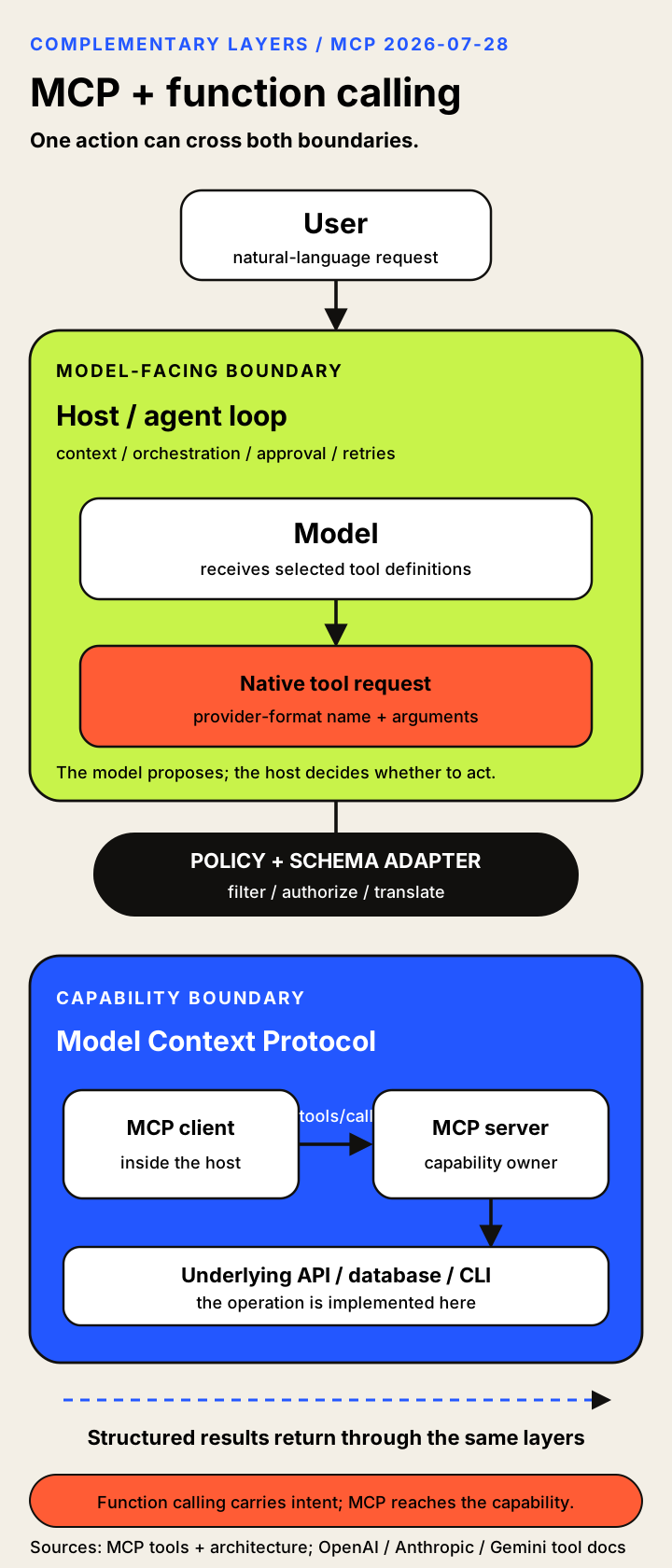
A useful comparison begins by separating four architectural layers.
| Layer | Principal question | Typical artifact |
|---|---|---|
| Model tool/function calling | What action is the model requesting? | Function declaration and structured tool call |
| Host or agent orchestration | Should the action run, and what happens next? | Agent loop, approvals, retries, context management |
| MCP | Where does the capability come from, and how is it invoked interoperably? | Host, MCP client, MCP server, JSON-RPC methods |
| Underlying system interface | How does the external system expose its actual operation? | REST, GraphQL, database protocol, SDK, CLI, local function |
The layers are separable even when a product hides them. An API provider may host the MCP connection and execute the entire round trip. An agent framework may normalize several model providers’ function-call formats. An MCP server may run in the same process as its client. None of those implementation choices makes the concepts identical.
A compact mental model
Natural-language request
        ↓
MODEL LAYER
Select a structured action
        ↓
HOST / AGENT LAYER
Filter, approve, route, retry, observe
        ↓
MCP LAYER (optional)
Discover and call an independently supplied capability
        ↓
SYSTEM LAYER
REST / GraphQL / database / SDK / CLI / local code
The central historical significance of MCP is the optional third layer. AI applications used tools before MCP. MCP attempted to make the capability boundary reusable across compatible applications rather than rebuilding each connector inside each host. Anthropic’s launch announcement described the pre-MCP problem as a proliferation of custom implementations and introduced MCP as a standard connection model. (Anthropic MCP launch, November 25, 2024 [S021])
2. What function calling actually is
Function calling is a model API convention for structured action selection. An application gives the model one or more tool definitions. A definition typically includes a name, a description, and a schema for the expected arguments. The model can answer normally or return a structured tool request. The application—or, for some provider-hosted tools, the provider—executes the operation and returns a result.
OpenAI publicly introduced function calling in its API on June 13, 2023. The original announcement described functions to GPT models and receiving a JSON object with arguments matching a function signature. It also warned that untrusted tool output could manipulate the model and recommended user confirmation for consequential actions. (OpenAI, “Function calling and other API updates” [S010])
The classic custom-function loop
1. Application defines tools.
2. Application sends tools and user input to the model.
3. Model returns ordinary text or a structured tool call.
4. Application validates and executes the requested function.
5. Application returns the tool result.
6. Model produces a final answer or requests another tool.
OpenAI’s current guide describes functions in a tools parameter with name, description, JSON Schema parameters, and a strict option. Anthropic describes client tools using name, description, and input_schema, returning tool_use blocks that application code executes. Google’s Gemini documentation similarly states that the model does not execute a custom function: the developer extracts the requested name and arguments, runs the function, and returns its result. (OpenAI function definitions [S169]; Anthropic tool use [S011]; Gemini function calling [S177])
Function calling is not ordinary function execution
A model returning:
{
  "name": "create_issue",
  "arguments": {
    "repository": "org/project",
    "title": "Fix OAuth redirect validation"
  }
}
has not itself created an issue. It has emitted structured data representing a requested action. The application still owns validation, authorization, execution, error handling, and the decision to return the result to the model.
This distinction matters because “the model called a function” is convenient shorthand, not a complete security or systems description.
Custom tools and provider-hosted tools
The traditional account—“your application executes the function”—is correct for custom client tools but no longer exhaustive.
- Anthropic distinguishes client tools, which the application executes, from server tools, which Anthropic executes.
- OpenAI exposes application functions, built-in hosted tools, hosted MCP tools, and tool search through one broader tools interface.
- Google SDKs can automate portions of the function-calling loop even though the external operation still occurs outside the model itself.
Therefore, function calling is best defined by the model-facing structured choice, not by a universal claim about which machine runs the code. (Anthropic tool execution distinction [S011]; OpenAI Agents SDK tools [S171])
3. What MCP actually is
For protocol definitions, roles, and examples, start with what MCP is and what an MCP server is. The tools, resources, and prompts comparison separates MCP’s three server primitives from provider-native tool calling.
MCP is a protocol through which clients communicate with servers that expose protocol-defined capabilities. It uses JSON-RPC 2.0 message structures but is not synonymous with JSON-RPC. JSON-RPC supplies generic request, response, notification, and error envelopes; MCP defines methods, types, transports, capabilities, authorization rules, version behavior, and extensions specific to the protocol. (JSON-RPC 2.0 [S001]; MCP base protocol [S130])
Host, client, and server
Historically and conceptually:
- The host is the coordinating AI application. It owns the user experience, model integration, permissions, and orchestration.
- The client implements the client side of MCP for a particular server relationship.
- The server implements the server side and exposes focused capabilities.
One product may contain both the host and client. A server is not the host, and the model is not the MCP client. Earlier specifications explicitly described one client–server session per connection; the 2026 revision changed the lifecycle and state model but not the usefulness of separating roles. (MCP launch-era architecture, 2024-11-05 [S025]; MCP 2026-07-28 release [S058])
MCP tools
In the current specification, a server may declare the tools capability and return tools through tools/list. A tool definition can include:
nametitledescription- icons
inputSchema- optional
outputSchema - annotations
The current default schema dialect is JSON Schema 2020-12 when $schema is absent. Tool annotations are explicitly untrusted unless they come from a trusted server. Tools can return text, images, audio, resource links, embedded resources, and structured content. (MCP tools, 2026-07-28 [S123])
MCP is broader than tools
MCP servers may also expose:
- Resources: URI-identified context or data that clients can list or read.
- Prompts: server-provided prompt templates intended to be surfaced or selected by users or applications.
- Extensions: independently versioned capabilities such as MCP Apps or Tasks.
- Other version-specific server and client capabilities.
Native function calling does not, by itself, define equivalent resource, prompt, transport, discovery, authorization, extension, or server-identity semantics. An application can build any of those around function calling, but they are not inherent in the function-call object. (MCP resources [S124]; MCP prompts [S125]; MCP extensions overview [S164])
4. The central difference: model interface versus capability interface
The cleanest distinction is:
Function calling is usually the interface between the model and its host application. MCP is the interface between the host application and an external or modular capability provider.
Function calling communicates model intent. MCP communicates with a server.
What function calling standardizes
Within one provider’s API, function calling typically standardizes:
- how tools are described to that model;
- how the model identifies the selected tool;
- how arguments are represented;
- how a tool result is associated with the call;
- how tool choice, strictness, and parallel calls are controlled.
What MCP standardizes
MCP standardizes a different set of concerns:
- how a client discovers server capabilities;
- how tools, resources, and prompts are listed;
- how a client invokes a tool;
- how results and errors are represented;
- how local or remote transports carry messages;
- how protocol revisions are identified;
- how remote authorization works;
- how optional capabilities and extensions are represented;
- how server implementations remain independent of one model API.
These sets overlap around schemas and tool invocation, which creates the confusion. But overlap is not equivalence.
5. How MCP and function calling work together
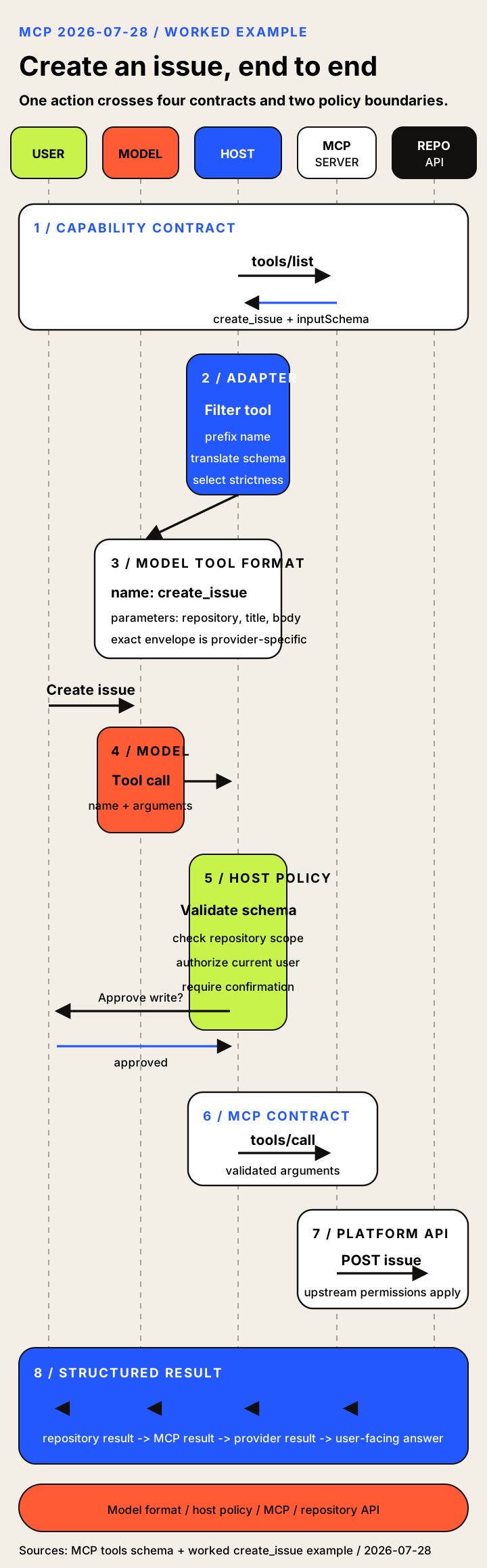
The lifecycle-focused companion explains how MCP works from request to result, while the role guide shows where the model and MCP client sit.
A host that connects to an MCP server generally needs to make the server’s tools useful to its model. The usual pattern is a translation layer:
- Call
tools/liston the MCP server. - Apply server allowlists, user permissions, product restrictions, and context-sensitive filtering.
- Convert selected MCP tool definitions into the model provider’s tool representation.
- Send those definitions to the model, or make them available through provider-side tool search.
- Receive the model’s structured tool request.
- Resolve the translated name back to the original server and tool.
- Invoke
tools/call. - Convert the MCP result into the provider’s tool-result representation.
- Continue the model or agent loop.
Official implementation evidence makes this more than an architectural inference. OpenAI’s Agents SDK has options to convert MCP tool schemas to strict JSON Schema on a best-effort basis, prefix tool names with a server identifier to prevent collisions, and still invoke the original MCP tool on the original server. It also supports provider-hosted remote MCP, where OpenAI’s infrastructure performs the listing and invocation rather than requiring a callback to the developer’s Python process. (OpenAI Agents SDK MCP [S090])
One issue-creation operation, end to end
Suppose the user says:
Create an issue in
acme/paymentstitled “Reject OAuth tokens with the wrong audience.”
Stage 1: the server publishes the capability
The repository MCP server returns a tool conceptually like:
{
  "name": "create_issue",
  "description": "Create an issue in a repository",
  "inputSchema": {
    "type": "object",
    "properties": {
      "repository": { "type": "string" },
      "title": { "type": "string" },
      "body": { "type": "string" }
    },
    "required": ["repository", "title"],
    "additionalProperties": false
  }
}
Stage 2: the host prepares the model-facing definition
The host may rename it to avoid a collision:
{
  "type": "function",
  "name": "github__create_issue",
  "description": "Create an issue in a repository",
  "parameters": {
    "type": "object",
    "properties": {
      "repository": { "type": "string" },
      "title": { "type": "string" },
      "body": { "type": "string" }
    },
    "required": ["repository", "title"],
    "additionalProperties": false
  },
  "strict": true
}
That representation is illustrative. The exact shape depends on the provider, SDK, and schema conversion rules.
Stage 3: the model requests the action
The model returns a structured call to github__create_issue with arguments.
Stage 4: the host evaluates the request
The host may:
- confirm the target repository;
- require user approval because this is a write operation;
- reject a disallowed organization;
- add tenant metadata;
- log the request;
- map the translated name to the original server and tool.
Stage 5: the client invokes MCP
Conceptually:
{
  "jsonrpc": "2.0",
  "id": 42,
  "method": "tools/call",
  "params": {
    "name": "create_issue",
    "arguments": {
      "repository": "acme/payments",
      "title": "Reject OAuth tokens with the wrong audience"
    }
  }
}
Current MCP requests carry required protocol-version and client-capability metadata in _meta; clientInfo is recommended but optional. The shortened example omits those fields for readability. (MCP tools [S123])
Stage 6: the server calls the underlying platform
The MCP server may invoke a REST or GraphQL endpoint, use a vendor SDK, or run local source-control code.
Stage 7: the result moves back up the stack
The server returns an MCP result. The host converts that result into the provider’s expected tool-result object and sends it to the model. The model then reports success, requests another action, or asks for missing information.
No layer replaces another:
Function calling selected the action.
The host authorized and routed it.
MCP carried the interoperable capability invocation.
The repository API performed the underlying business operation.
The agent loop continued the workflow.
6. Detailed comparison matrix
| Property | Native function calling | MCP |
|---|---|---|
| Primary concern | Model-facing structured action selection | Client–server capability interoperability |
| Core actors | Model provider API and application | Host, MCP client, MCP server |
| Capability definition owner | Usually the application or provider | MCP server |
| Discovery | Application supplies definitions; provider tool search may defer or retrieve them | Client lists or discovers server capabilities |
| Model required | Normally yes for the model-facing mechanism | No; a program can call MCP methods directly |
| Server required | No | A server-side implementation is required, though it may be in-process |
| Transport | Provider API protocol | stdio, Streamable HTTP, or conforming/custom transport |
| Wire basis | Provider-specific API objects | JSON-RPC 2.0 plus MCP semantics |
| Invocation object | Provider-specific tool/function call | tools/call request |
| Execution | Application, provider, or framework, depending on tool type | MCP server implementation |
| Underlying system | May call local code or external systems directly | Often wraps API, database, SDK, CLI, or local code |
| Input schemas | Provider-supported JSON Schema subset or custom format | Current MCP uses valid JSON Schema; default 2020-12 |
| Output schemas | Provider-specific structured output mechanisms | Optional MCP outputSchema and structuredContent |
| Resources | Not inherent | Native protocol primitive |
| Prompts | Not inherent | Native protocol primitive |
| Authorization | Application- or provider-specific | Defined framework for HTTP-based remote MCP |
| Versioning | Provider API/model/SDK versioning | Date-based MCP protocol revisions and extensions |
| Reuse across hosts | Requires shared library or adapter strategy | A principal design objective |
| Portability | Provider-native representation varies | Server can be reused by compatible clients, subject to capability differences |
| Tool naming scope | Provider/application scope | Unique within one server; aggregators must resolve collisions |
| Human approval | Application/provider feature | Host responsibility; protocol guidance and SDK support |
| State | Conversation or application may be stateful | Current protocol core is sessionless; applications can use explicit state |
| Long-running work | Application orchestration or provider feature | May use ordinary calls or Tasks extension |
| Parallelism | Provider-specific controls | Clients can issue concurrent calls; JSON-RPC batching is not part of current MCP |
| Error handling | Provider- and application-specific | JSON-RPC errors plus tool-result error semantics |
| Latency | Usually shortest path for in-process application tools | Adds client/server boundary; may be in-process, IPC, or network |
| Best fit | Small, tightly coupled, application-owned tool sets | Shared, independently operated, discoverable integrations |
| Security guarantee | None from the schema alone | None from protocol compliance alone |
7. Tool schemas: similar shape, different contract
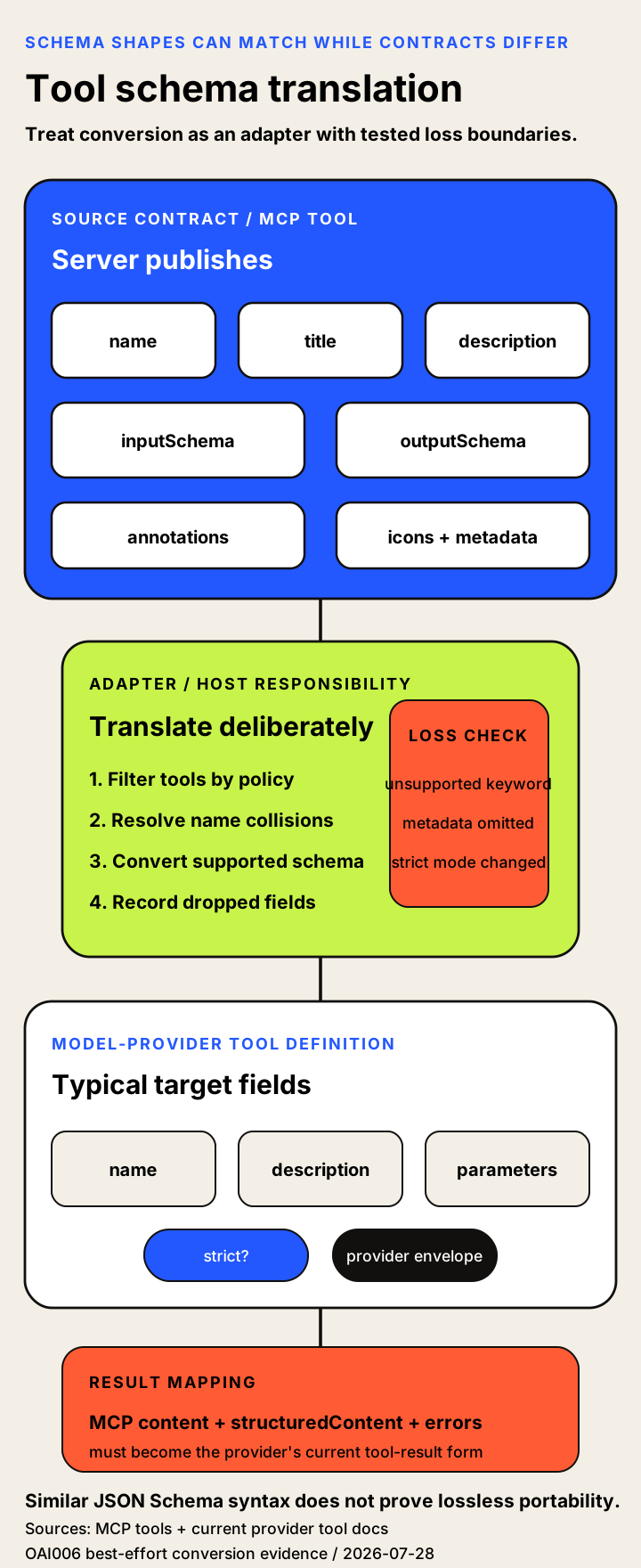
Both systems commonly use JSON Schema, but “both use JSON Schema” does not mean their contracts are identical.
MCP’s current tool schema
Current MCP tool definitions support a valid JSON Schema object for inputSchema, defaulting to dialect 2020-12 when $schema is absent. They may also include outputSchema, icons, annotations, and MCP-specific metadata. (MCP tools [S123])
Provider function schemas
Provider APIs usually support a subset or interpretation of JSON Schema. Strict modes can impose additional requirements. OpenAI’s strict function mode, for example, requires particular schema constraints; its docs also note that not every JSON Schema feature is supported. Google likewise documents a supported subset for function declarations. Anthropic offers strict tool use but has its own request and response envelopes. (OpenAI function calling [S169]; Gemini function calling [S177]; Anthropic tool use [S011])
Translation can be lossy
When a host converts an MCP tool to a provider-native function, it may need to:
- remove unsupported schema keywords;
- rewrite optional properties;
- add
additionalProperties: false; - shorten or sanitize names;
- flatten references;
- convert defaults or nullable values;
- omit MCP-only icons, annotations, or metadata;
- decide how to represent MCP content blocks;
- map errors into provider-visible text.
OpenAI’s Agents SDK calls strict conversion best effort, which is a useful warning against claiming automatic equivalence. (OpenAI Agents SDK MCP [S090])
Structured tool output is not model structured output
MCP structuredContent is structured data returned by an MCP tool. A model provider’s “structured output” feature constrains model-generated output to a schema. Those features may be composed, but they are not the same mechanism. Current MCP documentation explicitly treats tool result structure as part of the server result contract. (MCP tool results [S123]; OpenAI structured outputs [S172])
8. Discovery: MCP has it, but direct tools are no longer always static
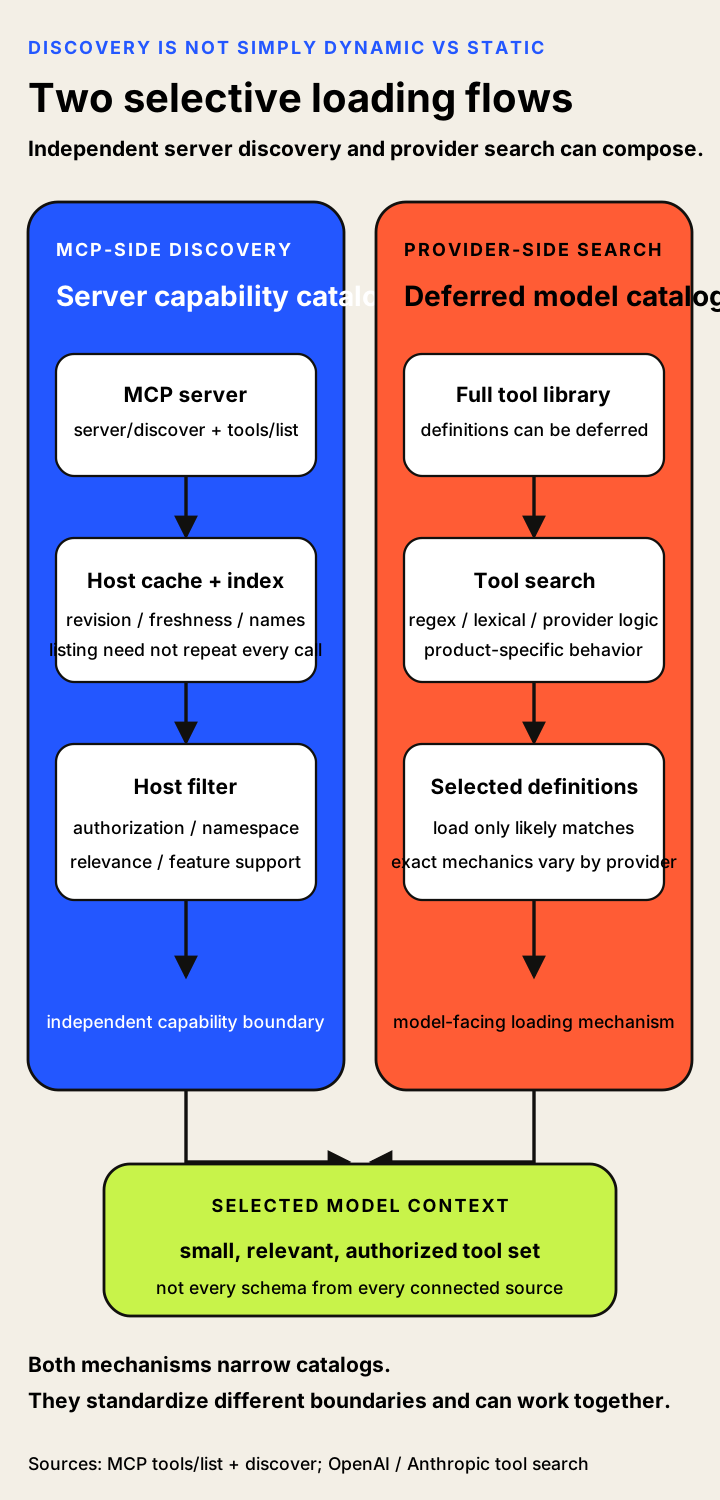
A common comparison says:
Function calling is static; MCP is dynamic.
That was a useful first approximation, but it is no longer universally accurate.
MCP discovery
An MCP client can list a server’s tools. In the current protocol, the effective tool set can vary with authorization context, and list results can include cache hints. Clients may listen for list-change notifications when supported. The 2026 revision also introduced server/discover for learning supported versions and capabilities without the former initialization handshake. (MCP tools [S123]; MCP discovery [S127])
Provider tool search
Modern provider APIs can also defer or search large tool catalogs:
- OpenAI supports tool search for deferred functions, namespaces, and hosted MCP servers.
- Anthropic’s tool search can search a large submitted catalog and load selected definitions on demand.
- Hosts can implement their own semantic or policy-based tool selection before sending any definitions to a model.
Thus the stronger distinction is:
MCP defines discovery across an independent server boundary. Provider tool search defines model-facing selection or loading within a provider’s tool system.
They can work together: a host can discover hundreds of MCP tools, index them, and expose only a small provider-native subset for a particular request.
(OpenAI Agents SDK tools [S171]; Anthropic tool search [S174])
9. Execution responsibility and control
In direct custom function calling
The application normally:
- decides which functions to expose;
- validates model-generated arguments;
- executes application code;
- catches exceptions;
- returns results;
- controls retries and timeouts;
- applies business authorization.
This gives the application maximum control and the fewest independently deployed components.
In MCP
The responsibility is divided:
- The server implements and executes the capability.
- The client speaks MCP and manages the server relationship.
- The host decides whether and how to expose the tool to the model.
- The model proposes a structured invocation.
- The underlying service enforces its own permissions and business rules.
This separation can improve reuse, but it does not remove host responsibility. The MCP tools specification recommends clear UI, visible invocation indicators, and the ability for a human to deny calls. It does not mandate one universal user interface. (MCP tools [S123])
An MCP server can be used without a model
MCP tools are designed to be model-controlled, but the specification explicitly permits other interface patterns. A test program, workflow engine, CLI, or deterministic application can list and call tools directly. This helps separate protocol semantics from AI product behavior. (MCP tools [S123])
10. MCP is not an agent loop
For the neighboring agent-to-agent layer, see MCP vs A2A.
Function calling is not an agent. MCP is not an agent. An MCP server is not automatically an agent.
An agent loop typically performs some combination of:
- collect state and user input;
- call a model;
- inspect requested tools;
- apply policy or obtain approval;
- execute or route tools;
- return results;
- update memory or context;
- repeat until completion, failure, or a limit.
MCP can supply capabilities to that loop. Function calling can express the model’s requested step. The loop remains responsible for repetition, stopping conditions, budgets, retries, delegation, and state management.
A server may itself perform agentic work behind one tool call, or expose a Tasks extension for long-running work. That does not convert the protocol as a whole into an “agent operating system.”
11. State: the most frequently outdated comparison
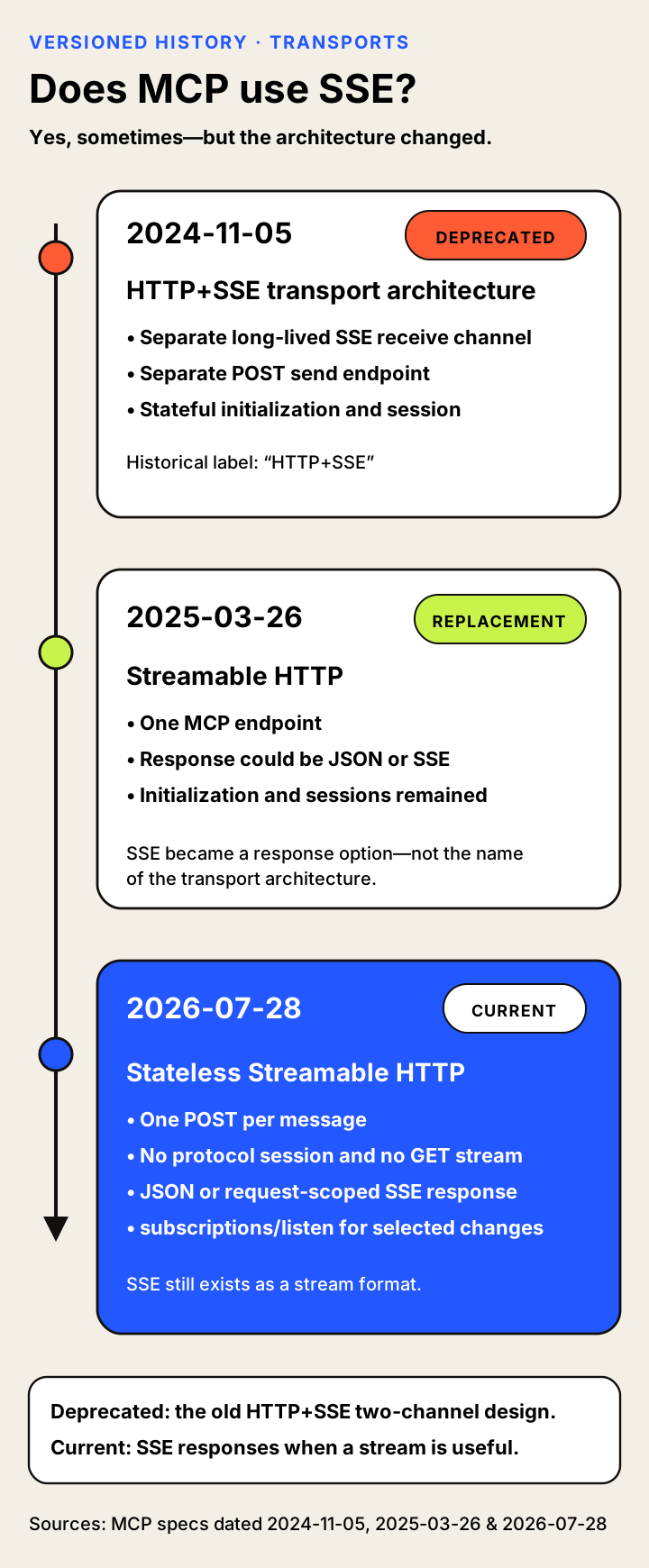
Use the MCP protocol versions guide to identify the wire era, then see the dedicated stateful-to-stateless migration guide and the 2026-07-28 release analysis.
Many pages published during 2025 describe:
| Function calling | MCP |
|---|---|
| Stateless | Stateful persistent session |
That comparison is no longer safe.
MCP through November 2025
Versions 2024-11-05, 2025-03-26, 2025-06-18, and 2025-11-25 used an initialization exchange. The client proposed a protocol version and capabilities; the server responded; the client sent notifications/initialized. Streamable HTTP could use Mcp-Session-Id. (MCP lifecycle, 2025-11-25 [S160])
MCP from July 28, 2026
The current revision removed:
initialize;notifications/initialized;- protocol-level sessions;
Mcp-Session-Id.
Each request carries required protocol-version and client-capability metadata; clientInfo remains optional. A client may call server/discover, but discovery is not a prerequisite to every useful request. The stated infrastructure goal is that requests can reach any server instance without sticky routing or shared session storage. (MCP 2026-07-28 release [S058])
Stateless protocol does not mean stateless application
A current MCP server can maintain a shopping cart, browser context, external job, or database transaction using an explicit handle. The specification advises returning the handle and requiring it in later calls rather than relying on implicit connection state. (MCP stateful tools guidance [S123])
Function-calling applications can also maintain conversation state, agent memory, server records, and provider response state. “Function calling is stateless” usually means the custom function interface does not itself establish an independent persistent tool session—not that the surrounding application lacks state.
12. Transport and deployment
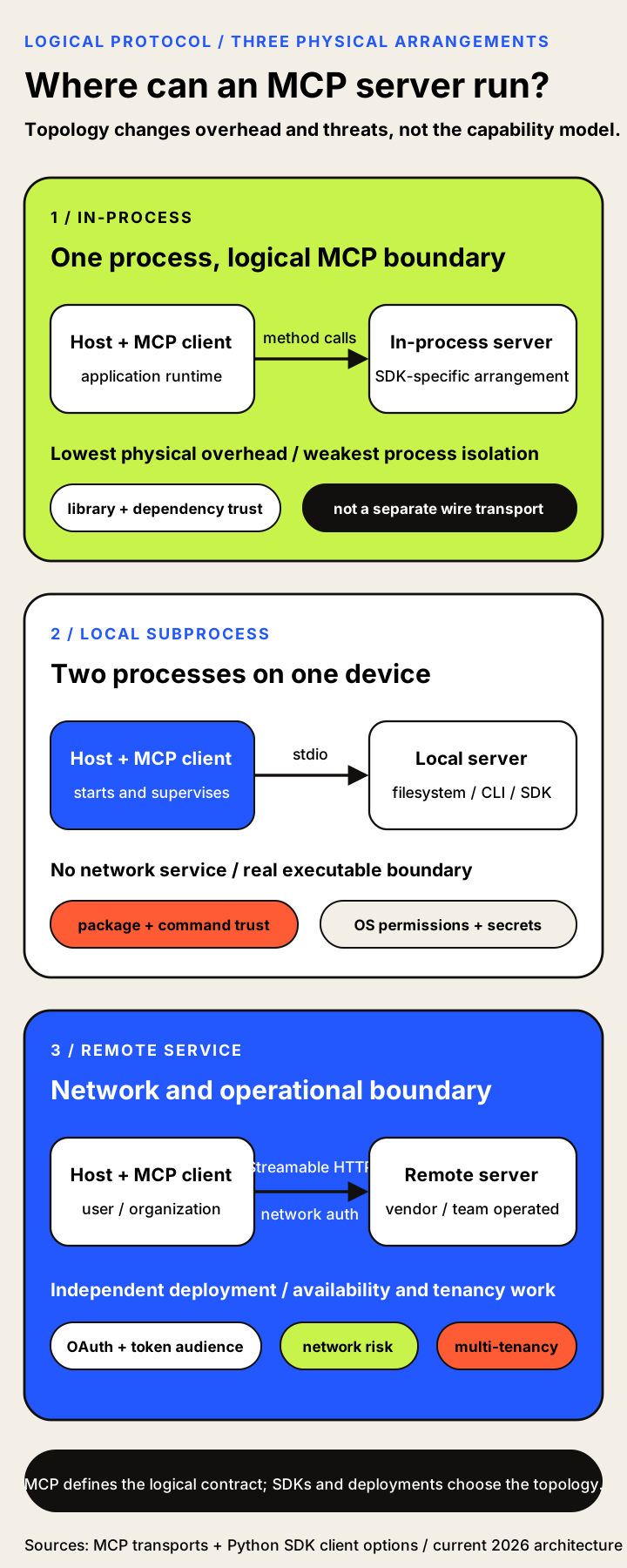
Our MCP transport guide separates stdio, Streamable HTTP, and retired HTTP+SSE behavior.
Direct function calling
For a custom application function, the only remote request may be the model API call. The actual tool can execute in the same process:
Application process
├── model API client
├── function schema
└── function implementation
This is operationally simple.
Local MCP
A host may spawn a server subprocess and exchange messages over stdio:
Host process
   │ stdin/stdout
   ▼
Local MCP server process
   ▼
Filesystem / CLI / SDK / local service
This adds process startup, package trust, environment variables, and IPC, but not necessarily a network hop.
Remote MCP
A host can communicate with a network service through Streamable HTTP:
Host / client
   │ HTTPS + OAuth where required
   ▼
Remote MCP service
   ▼
Vendor APIs / enterprise systems
This adds network latency, availability, multi-tenancy, OAuth, routing, and operational concerns. It also lets the capability provider deploy and update the server independently.
In-process MCP
The protocol roles do not logically require separate machines or even separate operating-system processes. Some SDKs permit an in-process server relationship. Therefore, “MCP always adds a network hop” and “MCP always requires a separate process” are false as universal claims. (MCP Python SDK client documentation [S167])
13. Authorization and permissions
Function calling has no single cross-provider authorization protocol for arbitrary custom functions. The application normally determines whether the current user may invoke the function, and the underlying service validates its own credentials.
MCP added an authorization framework as remote servers became important. The March 2025 revision introduced OAuth-oriented authorization for HTTP transports. June 2025 hardened resource-server behavior and token audience binding. Later revisions added further discovery and security rules. The current protocol continues to distinguish local stdio from remote HTTP authorization. (MCP 2025-03-26 changelog [S036]; MCP 2025-06-18 authorization [S044]; MCP 2026-07-28 changelog [S055]; current MCP security guidance [S134])
OAuth does not make a tool safe
OAuth can help answer:
- Which client is requesting access?
- On whose behalf?
- For which resource?
- Under which scopes?
- With which token audience?
It does not prove that:
- the server package is benign;
- a write operation is intended;
- tool descriptions are honest;
- external content is free from prompt injection;
- the server correctly preserves upstream permissions;
- the model selected the correct tool.
Authorization is necessary for many remote deployments, but it is one layer.
Permission inheritance is an implementation question
An MCP server may use:
- delegated per-user OAuth;
- a service account;
- server-owned credentials;
- user-supplied API keys;
- local environment credentials.
The protocol label alone does not reveal which upstream identity is used. A host must not assume that connecting as one user automatically preserves every permission boundary in the underlying service.
14. Security: neither side wins automatically
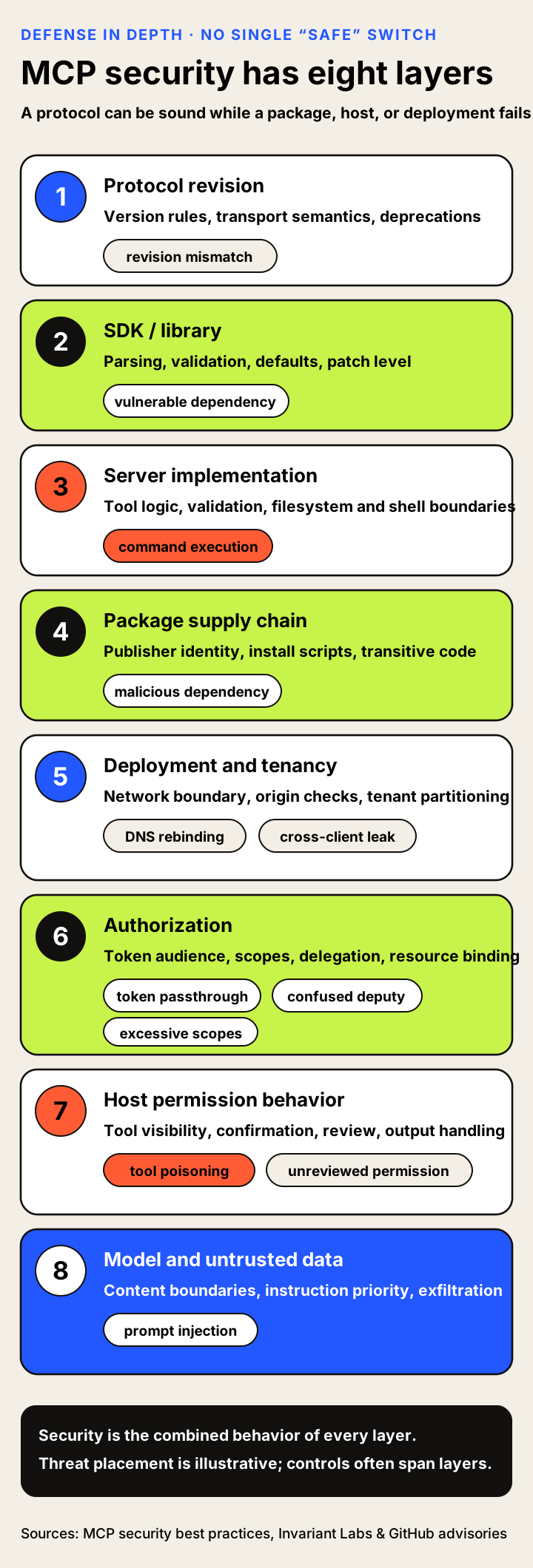
The MCP security guide maps the protocol, host, package, and upstream-system threat boundaries.
A two-column claim such as “MCP is more secure” or “direct functions are safer” is too broad.
Direct function-calling risks
- prompt injection from tool output;
- incorrect or malicious arguments;
- missing application authorization;
- dangerous local code;
- insufficient validation;
- overbroad service credentials;
- excessive automatic execution;
- business-logic abuse;
- provider or framework vulnerabilities.
OpenAI’s original 2023 announcement already warned that untrusted tool output could direct a model toward unintended actions and recommended confirmation for real-world impact. (OpenAI function-calling launch [S010])
Additional MCP risks
MCP can add:
- untrusted server packages;
- dependency and typosquatting risk;
- local code execution;
- malicious or misleading tool metadata;
- remote server compromise;
- OAuth and token-handling mistakes;
- cross-server tool-name collisions;
- multi-server prompt-injection paths;
- gateway and proxy misconfiguration;
- stale cached tool definitions.
Additional MCP controls
MCP can also create consistent places for:
- server allowlists;
- tool filters;
- approval policies;
- OAuth resource binding;
- gateways;
- audit and traces;
- schema validation;
- transport policy;
- per-server isolation;
- enterprise catalogs.
These benefits depend on implementation. Tool annotations are explicitly hints, not enforcement. A malicious server can lie about readOnlyHint; hard guarantees require authorization, sandboxing, network policy, or runtime controls. (MCP tool annotations analysis [S163])
A useful security decomposition
| Layer | Example responsibility |
|---|---|
| Model | Resist malicious instructions and select appropriate tools |
| Host | Filter tools, request approval, separate server context |
| Function-calling adapter | Validate translated schema and arguments |
| MCP client | Enforce protocol and transport behavior |
| MCP server | Implement tools safely and validate callers |
| Package/deployment | Maintain provenance, isolation, patches, secrets |
| Authorization | Bind identities, scopes, resources, and tokens |
| Underlying service | Enforce business permissions and data access |
15. Latency, cost, and operational overhead
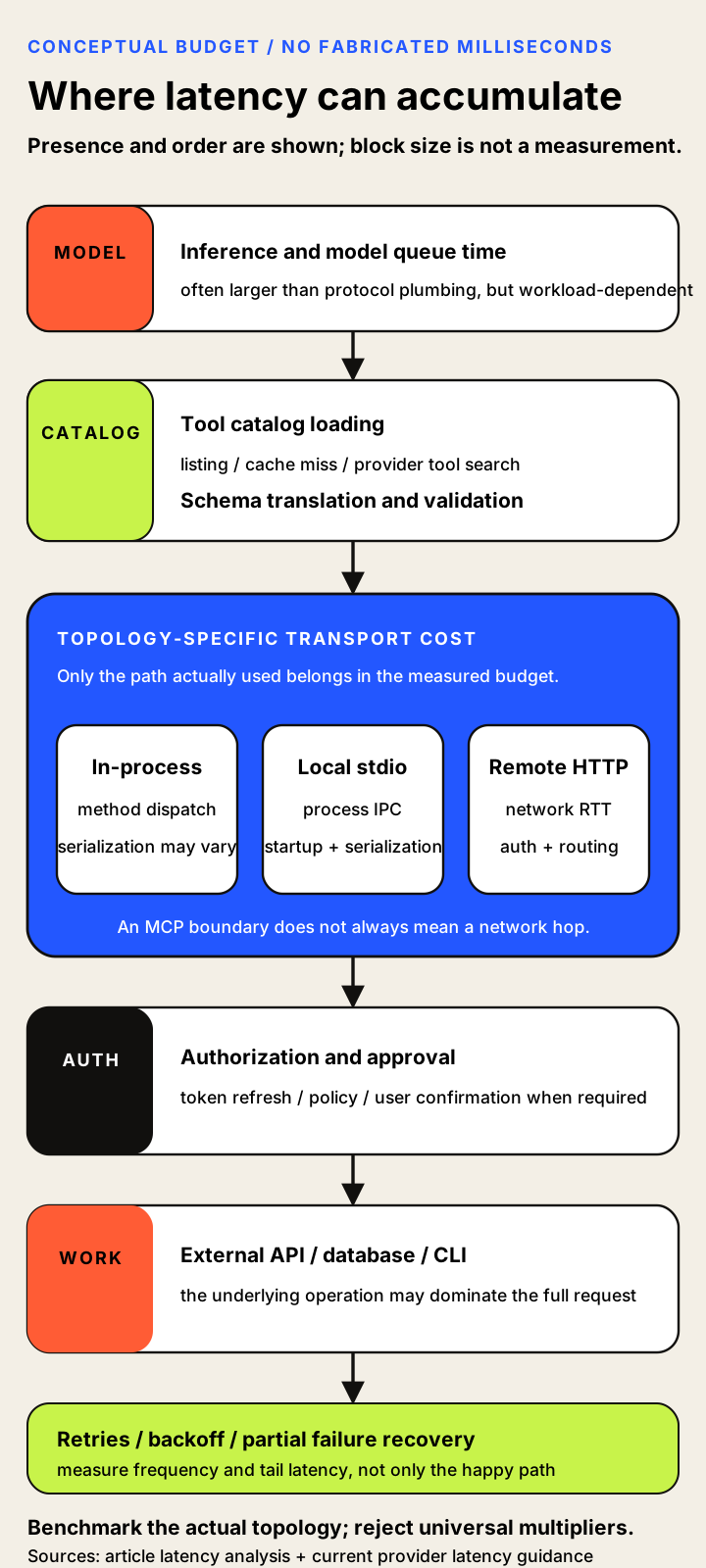
No protocol-level benchmark can establish that MCP is always slower or that direct function calling is always cheaper. The topology matters.
Direct function calling may minimize overhead when
- the tool is an in-process function;
- the schema is already known;
- one application owns the tool;
- there is no discovery request;
- there is no extra process or network boundary.
MCP may add
- local process startup;
tools/listor discovery work;- schema translation;
- IPC or network round trips;
- remote TLS and authorization;
- server cold starts;
- gateway processing.
Official OpenAI Agents SDK documentation notes that remote server listing can add noticeable latency and supports tool-list caching. The current MCP specification adds deterministic list order and cache hints to reduce repeated fetching. (OpenAI Agents SDK MCP caching [S090]; MCP 2026-07-28 release [S058])
But MCP overhead may be immaterial when
- the underlying API call dominates latency;
- the server is in-process;
- tool catalogs are cached;
- connections are reused;
- server-side execution eliminates application callbacks;
- one maintained server replaces several duplicated adapters.
The correct engineering approach is to benchmark the actual topology, including model latency, schema tokens, discovery, authorization, tool execution, and retries.
Do not import arbitrary web benchmarks
A comparison based on one application, one provider, one tool catalog, and one host does not establish general protocol performance. The article therefore makes no universal millisecond claim.
16. Context-window and tool-catalog cost
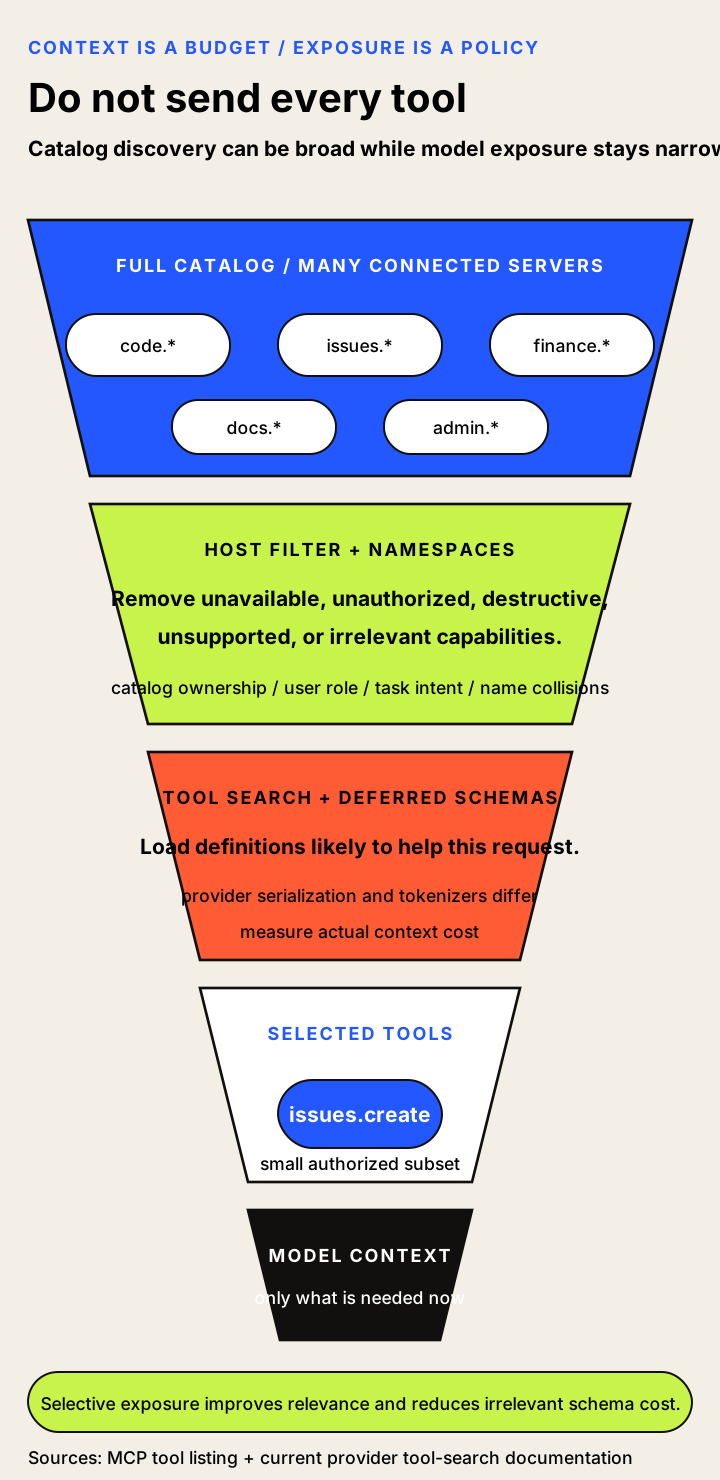
Both direct and MCP-derived tools can consume model context because the model needs enough metadata to select them. MCP does not force a host to inject every server tool into every request, but a naive host may do so.
Sources of cost
- tool names and descriptions;
- input schemas;
- output instructions;
- provider wrappers;
- duplicate tools from several servers;
- examples and annotations;
- repeated transmission without caching.
Anthropic documents tool search specifically to avoid loading every definition into model context, and cites large multiserver catalogs as a motivating case. OpenAI similarly supports deferred functions and hosted MCP servers through tool search. (Anthropic tool search [S174]; OpenAI Agents SDK tools [S171])
Scalable strategies
- connect only relevant servers;
- filter tools by user, task, or agent;
- namespace tools;
- search catalog metadata before loading full schemas;
- cache stable
tools/listresponses; - keep frequently used tools immediate;
- load rarely used tools on demand;
- evaluate tool-selection accuracy as catalogs grow.
The context problem is therefore not “caused by MCP.” It arises whenever many tool definitions are presented to a model, but MCP can make large catalogs easier to assemble and thus easier to mishandle.
17. Portability and interoperability
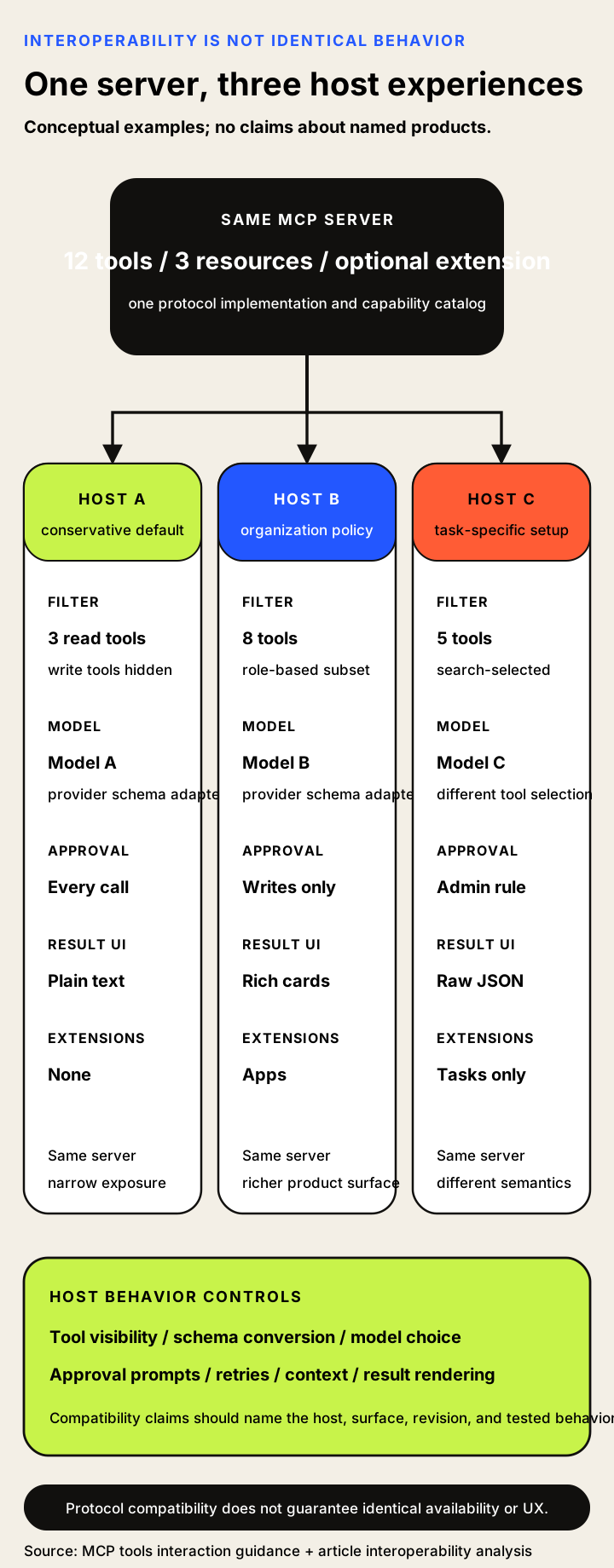
The maintained host compatibility matrix shows why one server can behave differently across products.
What MCP can port
A server implementation can, in principle, be reused by several compatible hosts without rewriting its underlying integration for each model provider. That is real architectural value.
What MCP does not guarantee
It does not guarantee:
- every host supports the same protocol revision;
- every host supports resources, prompts, Apps, Tasks, or elicitation;
- identical authorization flows;
- identical tool filtering;
- identical model behavior;
- identical result rendering;
- zero schema conversion loss;
- identical confirmation UX;
- identical limits on names or schemas.
Interoperability means that implementations share protocol semantics. It does not mean user experiences or model outcomes are identical.
Direct functions can also be portable
A function implementation can be shared through:
- an internal library;
- a service API;
- a framework abstraction;
- generated provider adapters;
- an OpenAPI description;
- a common domain layer.
MCP is not the only route to reuse. Its value is a standardized live capability boundary, not a monopoly on modular software design.
18. When direct function calling is the better choice
Choose direct function calling when most of these are true:
1. One application owns the entire stack
The same team owns the model loop, schemas, implementation, deployment, and user experience.
2. The tool set is small and stable
Two internal functions do not necessarily justify a protocol server.
3. The function is an implementation detail
A private calculate_discount or classify_ticket function may have no value outside one application.
4. Minimum moving parts matter
There is no need for a separate package, process, transport, server identity, OAuth flow, or discovery step.
5. Lowest possible local latency matters
An in-process function can avoid IPC and network overhead.
6. The application needs tight custom control
The code can tailor schemas, validation, retries, and error messages directly to one model and workflow.
7. Cross-host distribution is not a goal
No other AI application is expected to consume the capability.
Direct function calling is not a primitive or inferior stage that every serious system must outgrow. It is often the correct final architecture.
19. When MCP is the better choice
Choose MCP when several of these are true:
1. Multiple hosts need the same capability
An IDE, desktop assistant, support agent, and internal workflow may all need the same integration.
2. The capability provider and consumer are independent
A SaaS vendor or platform team can operate the server while several applications consume it.
3. Runtime discovery matters
The server controls which tools are available for a user, tenant, plan, or authorization state.
4. Local and remote deployments need a common abstraction
The same conceptual capability may run as a local subprocess for development and a remote service in production.
5. Capabilities extend beyond tool calls
Resources, prompts, Apps, Tasks, or other extensions are relevant.
6. A protocol boundary improves governance
The organization wants server catalogs, gateways, allowlists, authorization, audit, or centralized policy around capabilities.
7. Integration code should evolve independently
The server can update the underlying API logic without embedding that implementation in every host.
8. Vendor distribution matters
An API or SaaS provider wants to publish one official model-facing capability service rather than documentation for every host’s custom adapter.
MCP is most persuasive when the integration itself is a reusable product or infrastructure boundary.
20. When to use both
The hybrid pattern is likely to be the default for sophisticated systems.
Pattern A: MCP tools translated into native function calls
MCP tools/list
   ↓
Host filter and schema adapter
   ↓
Native model tools
   ↓
Model tool call
   ↓
MCP tools/call
Pattern B: direct internal tools plus MCP integrations
Agent
├── direct function: calculate internal score
├── direct function: update local state
├── MCP server: source control
├── MCP server: ticketing
└── MCP server: enterprise search
Pattern C: provider-hosted remote MCP
The application supplies a remote MCP server definition to a model API. The provider lists and invokes the server’s tools on the application’s behalf. The conceptual distinction remains, but the provider hides the client and translation plumbing. OpenAI and Anthropic both document remote MCP connector patterns. (OpenAI MCP and connectors [S170]; Anthropic MCP connector [S175])
Pattern D: MCP gateway plus several model providers
A gateway or host lists tools from several servers, applies policy, and translates the permitted subset into OpenAI, Anthropic, Google, or another provider’s native tool format. This maximizes reuse but puts substantial responsibility in the adapter and policy layer.
21. Provider comparison
| Feature | OpenAI | Anthropic | Google Gemini | MCP |
|---|---|---|---|---|
| Common term | Function calling / tool calling | Tool use | Function calling | Tools |
| Input schema field | parameters |
input_schema |
parameters |
inputSchema |
| Custom execution | Application | Application for client tools | Application | Server |
| Provider-hosted tools | Yes | Yes | Yes, product-dependent | Not a provider concept |
| Structured call object | Provider response item | tool_use block |
functionCall or function_call, depending on API surface |
JSON-RPC tools/call |
| Strict schema option | Yes | Yes | Provider/model dependent | Server schema; host conversion may be required |
| Tool search | Yes for supported models | Yes for supported models | Product-dependent | Server discovery/listing; host search is separate |
| Remote MCP support | Responses/Agents integrations | MCP connector | Gemini remote MCP support documented | Native protocol |
| Full cross-provider portability | No | No | No | Server-side objective, with host differences |
The table should not be read as a feature contest. Provider tool APIs and MCP solve adjacent problems.
22. MCP versus APIs and OpenAPI
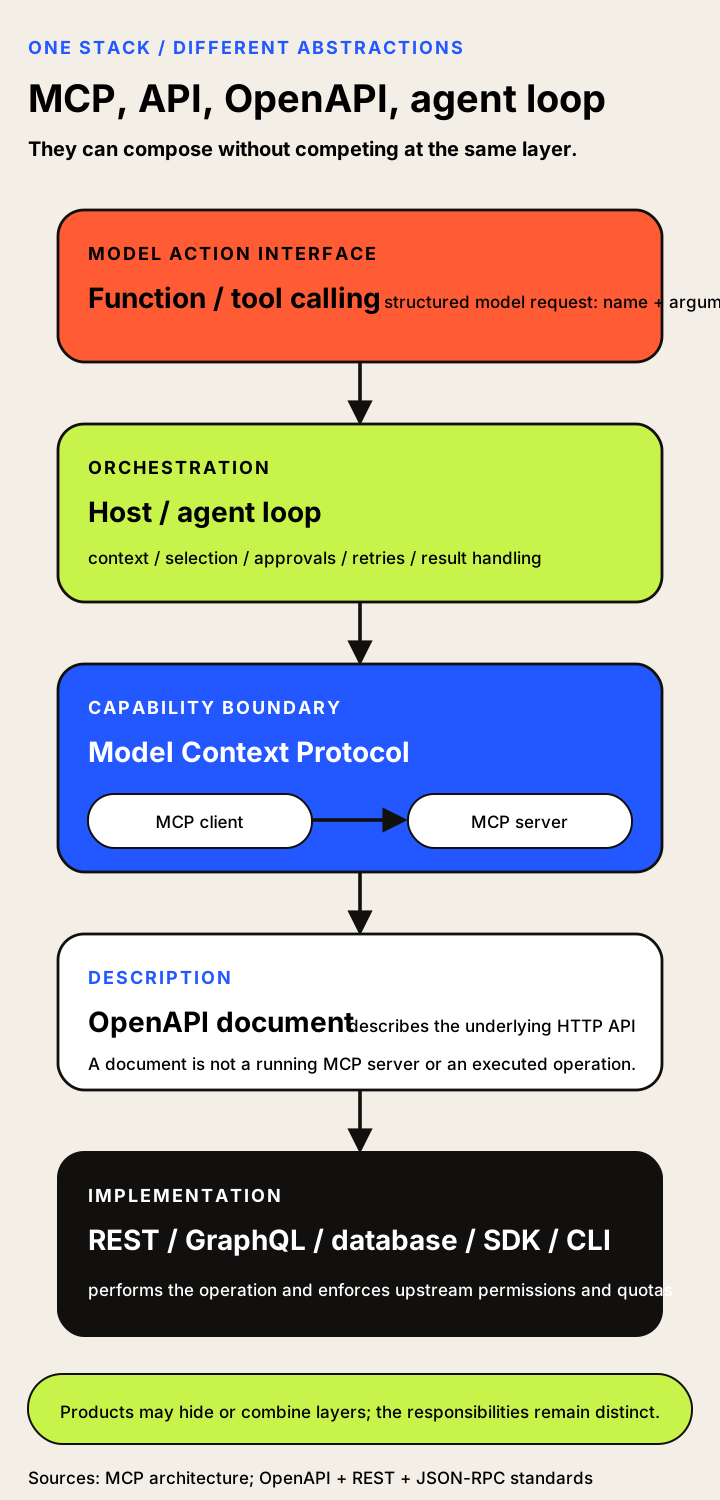
The focused MCP vs API guide expands the underlying-interface distinction.
MCP versus REST or GraphQL
MCP commonly sits above or alongside an application API:
Model tool request
   ↓
MCP client
   ↓
MCP server
   ↓
REST / GraphQL / database / SDK
REST and GraphQL remain general interfaces for websites, mobile apps, backend services, partners, and automation. MCP does not replace them.
MCP versus OpenAPI
OpenAPI is a machine-readable description of HTTP APIs. It can describe paths, operations, parameters, schemas, responses, and security. MCP is a live client–server protocol with capability discovery, invocation methods, transports, version rules, and additional primitives.
An OpenAPI document can be used to generate MCP tools, and an MCP server can wrap an OpenAPI-described service. Automatic conversion still requires choices about operation grouping, descriptions, authentication, schema compatibility, side effects, and model-facing semantics. (What is OpenAPI? [S179]; OpenAPI Specification [S180])
Function calling versus APIs
Function calling is not an alternative network API. It is how the model asks the application to perform an action. The application may satisfy that request with an in-process function or by calling an API.
23. MCP versus plugins
“Plugin” is a product or application-extension category, not one protocol.
- A ChatGPT plugin may use an MCP server in its modern implementation.
- An IDE plugin may implement an MCP host or server.
- A browser extension may connect to a local MCP server.
- An application connector may wrap MCP or use a proprietary interface.
A plugin is not automatically an MCP server, and an MCP server is not necessarily packaged as a plugin.
24. Historical evolution and why old comparisons conflict
Use the primary-source MCP history when reconciling claims from different protocol eras.
| Date/revision | Relevant comparison change |
|---|---|
| June 13, 2023 | OpenAI publicly launches API function calling |
| November 25, 2024 | Anthropic publicly introduces MCP |
2024-11-05 |
Initial MCP revision: tools, resources, prompts, stdio, HTTP+SSE, initialization/session model |
2025-03-26 |
OAuth framework, Streamable HTTP, annotations, batching |
2025-06-18 |
Batching removed, structured tool output, auth hardening, elicitation |
2025-11-25 |
Richer elicitation and sampling, experimental Tasks, governance additions |
2026-07-28 |
Stateless core, no handshake/session, MRTR, routing headers, cacheable lists, extensions, Tasks moved out of core |
The rapid changes explain several contradictory articles:
- “MCP uses SSE” may describe the launch transport, not current architecture.
- “MCP requires a persistent session” was correct for earlier revisions, not the current one.
- “MCP has JSON-RPC batching” was true in March 2025 and false by June.
- “Tasks are part of core MCP” describes the experimental November 2025 form, not their current extension status.
Version dates are therefore not decorative details. They determine the architecture being compared. (March 2025 changelog [S036]; June 2025 changelog [S043]; current MCP changelog [S055])
25. Common myths and corrections
Myth 1: MCP replaces function calling
Correction: MCP tools are often exposed to the model through native function calling. They are complementary layers.
Myth 2: MCP is function calling over HTTP
Correction: MCP also defines discovery, JSON-RPC methods, transports, resources, prompts, authorization, revisions, server metadata, and extensions.
Myth 3: Function calling always executes code in the application
Correction: Custom client tools usually do, but providers also expose hosted/server tools.
Myth 4: Function calling is always static
Correction: Provider tool search and deferred loading can dynamically narrow large catalogs.
Myth 5: MCP always requires a remote server
Correction: Servers can run locally over stdio or in-process through SDK facilities.
Myth 6: MCP always adds a network hop
Correction: Local and in-process topologies need not use a network.
Myth 7: MCP is stateful; function calling is stateless
Correction: That comparison describes older MCP revisions. Current MCP has a stateless protocol core, while both surrounding applications can maintain state.
Myth 8: An MCP server is an agent
Correction: It is a server-side protocol implementation. It may expose agentic work, but need not reason or plan.
Myth 9: MCP tools are automatically safe
Correction: Tool annotations are untrusted hints; safety depends on every layer.
Myth 10: OAuth makes an MCP server secure
Correction: OAuth addresses delegated access and token handling, not package trust, prompt injection, business logic, or model behavior.
Myth 11: One MCP server behaves identically in every host
Correction: Hosts differ in supported revisions, capabilities, models, approvals, filters, and rendering.
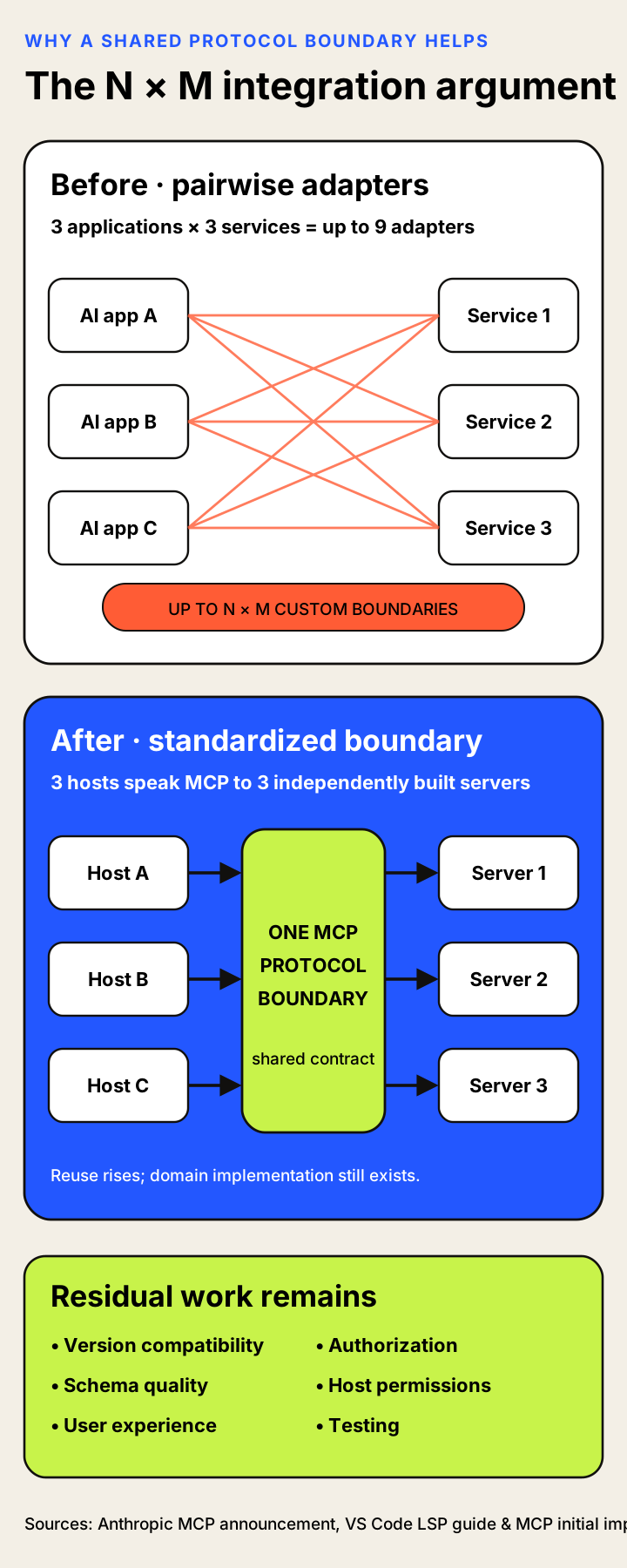
Myth 12: MCP eliminates all N × M integration work
Correction: It can reduce repeated protocol adapters, but hosts still need compatibility, policy, UX, and schema translation.
Myth 13: MCP replaces REST APIs
Correction: MCP servers frequently call REST APIs.
Myth 14: MCP structured output is the same as model structured output
Correction: One structures a server tool result; the other constrains model-generated output.
Myth 15: Native function calling is obsolete
Correction: It remains the model-facing mechanism in many MCP hosts and is often the simplest choice for internal tools.
26. Production architecture patterns
Pattern 1 — Inline application tools
Model API ↔ Host application ↔ Internal function/service
Use when: one team owns the stack, the catalog is small, and reuse is low.
Advantages: fewest moving parts, direct debugging, low overhead.
Risks: provider/tool coupling, duplicated integrations across products, capability deployment tied to host releases.
Pattern 2 — Local stdio MCP server
Model API ↔ Host/MCP client ↔ local subprocess ↔ filesystem/CLI/local SDK
Use when: a desktop or developer tool needs a focused local capability.
Advantages: reusable server package, process boundary, no internet service required.
Risks: arbitrary package execution, environment-variable secrets, broad filesystem access, startup latency, upgrade provenance.
Pattern 3 — In-process MCP adapter
Model API ↔ Host/MCP client ↔ in-process MCP server ↔ internal library
Use when: the protocol abstraction is valuable but an extra process or network hop is not.
Advantages: testable protocol boundary with low physical overhead.
Risks: SDK-specific arrangement, weaker isolation, no automatic operational independence.
Pattern 4 — Remote vendor MCP server
Model API ↔ Host/MCP client ↔ Streamable HTTP ↔ vendor MCP service ↔ SaaS API
Use when: a vendor publishes and operates its own reusable integration.
Advantages: independent updates, delegated authorization, multi-host distribution.
Risks: remote availability, OAuth complexity, tenant isolation, rate limits, data handling, support burden.
Pattern 5 — Enterprise MCP gateway
Several hosts ↔ enterprise gateway/policy layer ↔ approved local and remote servers
Use when: an organization needs centralized allowlists, authentication, routing, audit, and server governance.
Advantages: common policy point and observability.
Risks: gateway becomes a high-value trust and availability boundary; protocol compatibility still does not guarantee semantic compatibility.
Pattern 6 — Hybrid internal and MCP tools
Model
 ├─ direct internal functions
 └─ MCP tools from approved servers
Use when: internal implementation details should remain direct while distributable integrations use MCP.
Advantages: avoids forcing every tool behind a server.
Risks: two tool lifecycles and permission models must be presented coherently.
Pattern 7 — Multi-model MCP platform
OpenAI / Claude / Gemini adapters
              ↕
      shared host policy layer
              ↕
         MCP clients/servers
Use when: the same integrations support several model providers.
Advantages: capability providers can remain model-independent.
Risks: schema and result conversion may be lossy; models select tools differently; provider-specific features still require adapters.
Pattern-selection table
| Requirement | Inline tools | Local MCP | In-process MCP | Remote MCP | Gateway |
|---|---|---|---|---|---|
| Lowest architectural overhead | Strong | Medium | Strong | Weak | Weak |
| Reuse across hosts | Weak | Medium | Medium | Strong | Strong |
| Independent vendor operation | Weak | Weak | Weak | Strong | Strong |
| Local system access | Medium | Strong | Strong | Weak | Medium |
| Remote delegated authorization | Weak | Weak | Weak | Strong | Strong |
| Central enterprise policy | Weak | Medium | Medium | Medium | Strong |
| Process isolation | Weak | Medium | Weak | Strong boundary | Variable |
| Multi-tenant scaling | Application-specific | Weak | Weak | Strong potential | Strong potential |
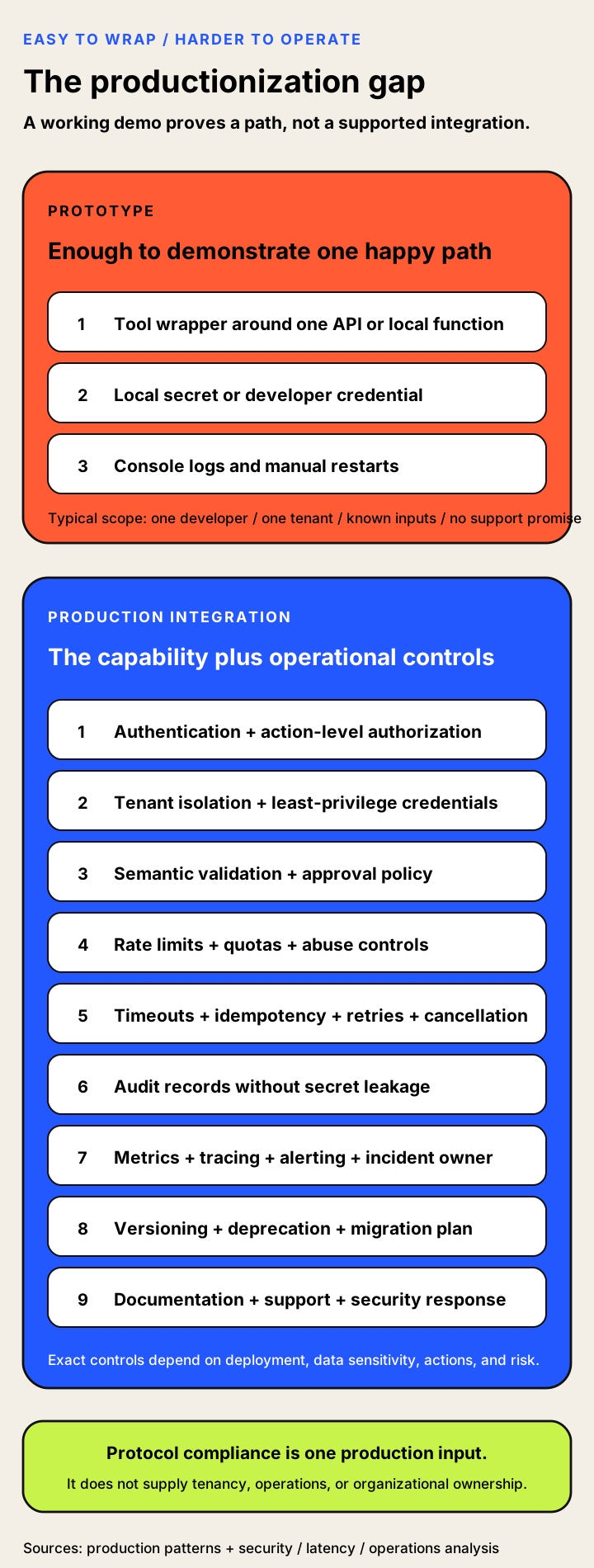
Productionization controls shared by all patterns
- Least-privilege credentials and upstream permissions.
- Schema validation plus semantic validation.
- Explicit policy for destructive or open-world actions.
- Tool catalog filtering and name-collision handling.
- Prompt-injection and untrusted-output handling.
- Idempotency, retries, cancellation, timeouts, and rate limits.
- Audit records that identify user, host, server, tool, arguments, authorization context, and outcome without leaking secrets.
- Version and deprecation strategy.
- Incident response and ownership.
27. Decision framework
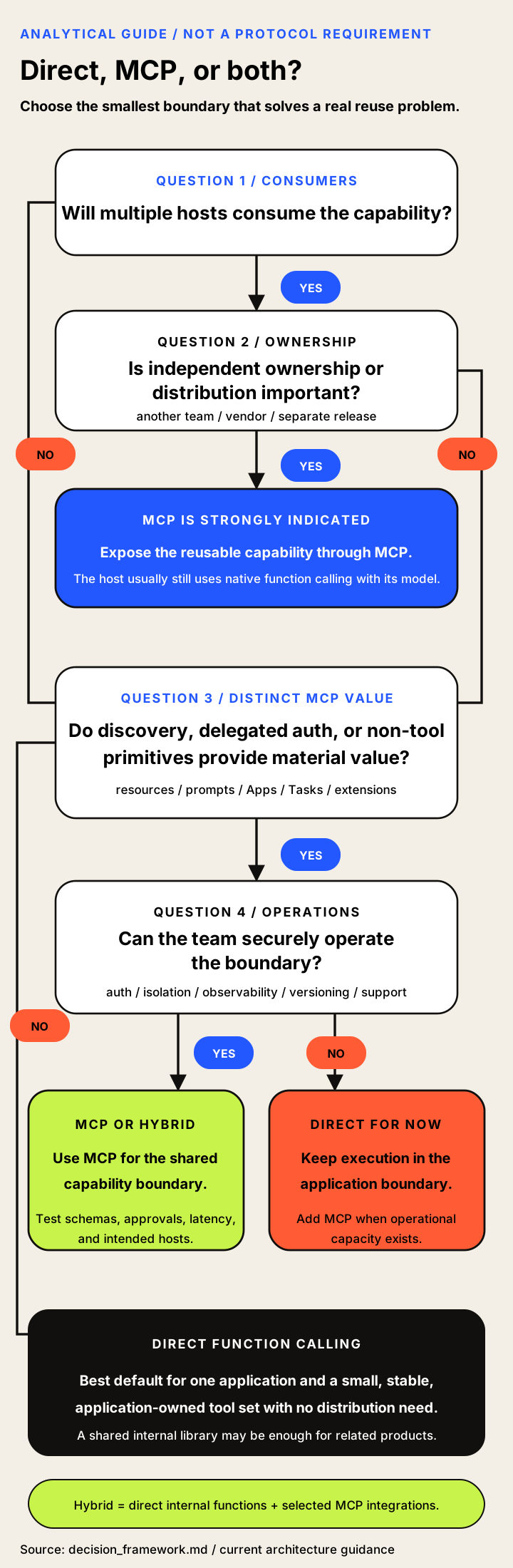
Answer these questions in order.
Question 1: Will more than one host consume the capability?
- No: direct function calling remains attractive.
- Yes: MCP gains value.
Question 2: Is the capability owned by the same team as the host?
- Yes: direct integration may be simpler.
- No: an MCP boundary can clarify ownership and deployment.
Question 3: Must the capability be discovered or changed independently?
- No: inline schemas may be enough.
- Yes: MCP listing and server ownership help.
Question 4: Is the tool an internal implementation detail?
- Yes: keep it direct unless there is another reason to externalize it.
- No, it is an integration product: consider MCP.
Question 5: Is an additional runtime boundary acceptable?
- No: direct in-process functions.
- Yes: local or remote MCP may be appropriate.
Question 6: Do resources, prompts, Apps, Tasks, or protocol authorization matter?
- No: function calling may cover the need.
- Yes: MCP supplies a broader foundation.
Question 7: Does the organization need centralized server approval or gateways?
- No: either approach.
- Yes: MCP offers a more standard policy boundary, though platform features remain implementation-specific.
Question 8: Can the team operate the server securely?
A prototype wrapper may be easy to build. Production authorization, secrets, rate limits, retries, auditing, tenant isolation, schema evolution, and support are not automatic.
Decision shorthand
One app + a few internal tools
    → Direct function calling

Several apps + reusable integration
    → MCP

MCP integration selected by a model
    → MCP + native function calling

Deterministic workflow with no model decision
    → Programmatic code; MCP only if the capability boundary is useful
28. Frequently asked questions
What is the main difference between MCP and function calling?
Function calling is the model-facing mechanism for requesting a structured action. MCP is the client–server protocol through which an application can discover and invoke independently supplied capabilities. A host commonly uses both.
Does MCP replace function calling?
No. A model still needs some mechanism to select an action, and native function or tool calling is a common choice. MCP supplies the capability boundary rather than replacing the model-facing selection mechanism.
Does function calling replace MCP?
No. Direct function calling can avoid MCP when an application owns its tools, but it does not inherently define MCP’s server discovery, transports, remote authorization, resources, prompts, or extensions.
Can function calling work without MCP?
Yes. Most application-defined tool integrations can be implemented directly with a model provider’s function-calling API.
Can MCP work without function calling?
Yes. An MCP client can list and invoke capabilities programmatically. A user interface, workflow engine, test harness, or deterministic application can call MCP without asking a model to choose the tool.
Can MCP work without an LLM?
Yes. MCP is a protocol, not a model. Model reasoning is a common consumer but not a protocol prerequisite.
Is an MCP tool the same as an OpenAI function?
No. An MCP tool is published by an MCP server. A host may translate it into an OpenAI function definition, but schema conversion, naming, result handling, and approval behavior remain adapter concerns.
Is MCP just function calling over HTTP?
No. MCP can use stdio or in-process arrangements as well as HTTP, and it defines considerably more than a tool-call payload: roles, discovery, resources, prompts, versioning, transport behavior, authorization, and extensions.
Is MCP an API?
MCP is a protocol/interface specification. An MCP server exposes a protocol API, but MCP should not be equated with the underlying product API that the server may call.
Does MCP replace REST APIs?
No. An MCP server frequently calls REST, GraphQL, a database, a CLI, an SDK, or local code. MCP creates a model-application-facing capability boundary above or alongside those interfaces.
What is the difference between MCP and OpenAPI?
OpenAPI describes HTTP APIs. MCP defines runtime communication between clients and capability servers. An OpenAPI description may be used to generate or inform an MCP server, but it is not itself a running MCP implementation.
Does MCP use JSON-RPC?
Yes. MCP uses JSON-RPC 2.0 message structures, while defining its own methods, types, transports, capabilities, version rules, and extensions.
Does function calling use JSON-RPC?
Not necessarily. Provider function-calling formats are model API contracts and need not use JSON-RPC. A host may convert a provider tool request into an MCP JSON-RPC request.
Who executes a native function call?
For a custom client tool, application code normally executes it. Some providers also offer hosted tools that they execute. The model itself emits a structured request rather than running arbitrary application code.
Who executes an MCP tool?
The MCP server handles the tools/call request and performs or delegates the operation. The host decides whether and how the request reaches the server.
Who decides which MCP tools the model can see?
The host application. It may filter by server, user, policy, context, risk, tool name, schema, or product support before translating tools into the model provider’s format.
Can one MCP server work with multiple model providers?
Potentially, yes. Different hosts can connect to the same server, but adapters may translate schemas and results differently. Protocol compatibility does not guarantee identical model behavior or user experience.
Is MCP vendor-neutral?
The specification is designed for cross-vendor implementation and has multi-vendor governance and adoption, but individual hosts, SDKs, servers, extensions, and hosted services can remain vendor-specific.
Is function calling vendor-neutral?
The general pattern is shared, but the wire formats and features of OpenAI, Anthropic, Google, and other providers differ. Frameworks can normalize them, but there is no single universal provider function-call format.
Which is easier to build?
A few direct application functions are usually easier. A minimal MCP wrapper can also be easy to prototype, but secure production operation, authorization, compatibility, versioning, and support are materially harder.
Which is faster?
There is no universal answer. Direct in-process execution minimizes boundaries, while MCP may be in-process, local, or remote. Model latency and the underlying external operation often dominate. Measure the actual deployment.
Which is cheaper?
Direct integration can have lower operational overhead for small systems. MCP may reduce duplicated integration work across several hosts. Total cost depends on reuse, deployment, model context, auth, maintenance, and support.
Which is more secure?
Neither is inherently secure. Direct functions have fewer components but may be overprivileged or poorly validated. MCP can centralize policy but adds packages, servers, transports, authorization, and supply-chain risks.
Does OAuth make remote MCP safe?
No. OAuth helps authorize access. It does not make tool code correct, prevent prompt injection, verify packages, enforce tenant isolation, or guarantee appropriate host confirmation.
Are MCP tool annotations security controls?
No. They are descriptive hints and must be treated as untrusted unless the server is trusted. Hosts may use them to inform risk vocabulary or user interfaces, not as proof of behavior.
Does MCP solve prompt injection?
No. Tool descriptions, resource content, tool output, external documents, and user input can all carry untrusted instructions. MCP transports capabilities and content; it does not eliminate model-level injection.
Does MCP always require user approval?
No universal wire-level rule forces identical approval behavior. Hosts are expected to preserve user control, but confirmation policy depends on the host, tool, server trust, administrative settings, and action risk.
Does native function calling always require approval?
No. Approval is application or provider behavior. Consequential actions should generally be confirmed or constrained, but the function-call object itself is not a consent system.
Is MCP stateful?
Historically, 2024–2025 MCP used initialization and protocol-session semantics. The current 2026-07-28 core removed the initialization handshake and protocol-level sessions.
Is current MCP stateless?
The current core is stateless at the protocol-request layer. Applications can still maintain database, authorization, task, conversation, and explicit-handle state.
What happened to MCP sessions?
The 2026-07-28 revision removed protocol sessions and Mcp-Session-Id, replacing hidden connection state with self-describing requests and explicit application state where needed.
Does MCP use SSE?
Current Streamable HTTP may use SSE for request-scoped streaming or selected subscriptions. The original two-endpoint HTTP+SSE transport is a deprecated historical design.
What is Streamable HTTP?
It is MCP’s HTTP transport architecture introduced in March 2025. It uses an HTTP endpoint and can return ordinary JSON or an SSE stream when streaming is needed. Its current semantics differ from its original session-era form.
Does MCP always add a network call?
No. A server can run locally over stdio or, depending on the SDK/application, in process. Remote MCP adds network boundaries.
What does tool discovery mean in MCP?
The client can ask a server for its tool catalog and receive metadata and schemas. Hosts may cache or filter that catalog and may not expose every tool to the model.
Does native function calling support tool discovery?
Provider APIs increasingly support tool search, namespaces, or deferred loading, but these mechanisms discover tools within the provider or host’s tool environment rather than establishing an independent MCP server relationship.
Why can schema translation be lossy?
MCP and model providers use related but non-identical schema contracts, names, metadata, content types, and restrictions. An adapter may omit unsupported JSON Schema features or change how outputs and errors are represented.
What is strict function calling?
In provider APIs, strictness generally means constraining generated tool arguments to the declared schema. It does not validate the real-world safety, authorization, or semantic correctness of executing the action.
Is MCP structured output the same as structured model output?
No. MCP structured tool output is produced by the server and described by a tool output schema. Structured model output constrains data generated by the model.
Are MCP resources functions?
No. Resources are URI-identified data or context that clients can list/read. They are distinct from effectful tool invocations.
Are MCP prompts system prompts?
Not necessarily. MCP prompts are server-exposed prompt templates that a host can surface or use. They are not automatically the model’s system message.
Are MCP servers agents?
Not inherently. A server may expose deterministic tools or data. An agent may use MCP, and a server may perform agentic work internally, but those are implementation choices.
Can an MCP server call another MCP server?
An implementation can act as both a client and a server or route through a gateway, but that composition is an application architecture rather than proof that every server is an autonomous agent.
When should I use direct function calling?
Use it when one application owns a small, stable tool set, minimal overhead matters, the functions are internal details, and cross-host distribution is not a goal.
When should I use MCP?
Use it when capabilities need independent ownership, runtime discovery, reuse across hosts, local/remote interchangeability, remote authorization, distribution, or MCP primitives beyond tools.
When should I use both?
Use both when a host discovers and filters MCP tools, translates them into the selected model’s native tool format, receives the model’s request, and invokes the server through MCP.
Should every internal function become an MCP tool?
No. Protocol boundaries are justified by reuse, ownership, distribution, governance, or deployment needs—not by the existence of a function.
Can MCP reduce integration duplication?
Yes, when several compatible hosts can reuse one server implementation. It does not eliminate model-provider adapters, auth differences, host policy, semantic testing, or user-experience work.
Does MCP guarantee interoperability?
It provides protocol interoperability for supported revisions and capabilities. Real interoperability still depends on transport, auth, optional features, schema translation, extension support, and host behavior.
What is the current MCP specification?
As verified on August 25, 2026, the current released revision is 2026-07-28. This answer must be live-checked at publication and during future updates.
29. Recommended implementation principles
- Name the layer in design documents. Say “model tool call,” “MCP tool,” “underlying API operation,” or “agent step,” not merely “tool.”
- Pin the protocol revision. Do not document current MCP using a 2025 lifecycle diagram.
- Treat schema conversion as an adapter. Test it across providers.
- Filter before exposing. The server’s complete catalog need not become the model’s complete catalog.
- Require approval based on real risk. Do not rely solely on annotations.
- Preserve upstream identity intentionally. Document whether the server uses delegated users or service credentials.
- Measure actual topology. Include tool listing, model calls, server calls, and downstream APIs.
- Keep direct functions direct when appropriate. Standardization is not free.
- Use explicit state handles. Do not assume current MCP supplies protocol sessions.
- Test more than connection success. Verify auth, schemas, errors, content types, optional features, and host behavior.
Conclusion
MCP and function calling belong in the same architecture more often than they belong on opposite sides of a technology choice.
Function calling gives a model a structured way to request an action. MCP gives an application a standardized way to obtain and invoke capabilities from independently implemented servers. An agent loop coordinates repeated model and tool interactions. REST, GraphQL, databases, SDKs, CLIs, and local functions remain the systems that actually implement much of the work.
Direct function calling is the right answer when one application owns a few internal tools and values simplicity. MCP is compelling when capabilities must be shared, discovered, distributed, operated independently, authorized remotely, or represented with primitives beyond functions. A hybrid host can use direct functions for internal logic and MCP for reusable integrations while presenting both through one model-native tool interface.
The most important correction to current search results is historical: modern MCP is not the same session-oriented protocol launched in 2024. The 2026-07-28 revision removed the handshake and protocol sessions, formalized a stateless core, added routable and cacheable HTTP behavior, and moved major capabilities into extensions. Comparisons that ignore the protocol version are likely to misstate architecture, performance, and state.
The durable conclusion is simpler:
Function calling communicates the model’s requested action. MCP standardizes the capability boundary that can fulfill it.
Update log
- August 25, 2026: Initial publication against MCP
2026-07-28; normalized two unmanifested link targets, narrowed the request-metadata statement to match the current specification, and retained the original package claims in the public correction record.
Sources and methodology
Browse the unified evidence library and the editorial and update policy for source, durability, correction, and review rules.
This article prioritizes current and versioned MCP specifications, official MCP project material, current provider documentation, official SDK documentation, and primary standards sources. Current-product behavior was verified on August 25, 2026. No proprietary keyword-volume estimate or universal performance benchmark is presented.
Core sources:
- MCP tools,
2026-07-28[S123] - MCP base protocol,
2026-07-28[S130] - MCP transports,
2026-07-28[S057] - MCP discovery,
2026-07-28[S127] - MCP
2026-07-28release [S058] - OpenAI function calling [S169]
- OpenAI Agents SDK MCP [S090]
- Anthropic tool use [S011]
- Anthropic tool search [S174]
- Gemini function calling [S177]
- JSON-RPC 2.0 [S001]
- OpenAPI Specification [S180]