MCP vs API: Differences and When to Use Each
Compare MCP with REST and other APIs through one customer lookup: what the adapter adds, which permissions remain, and when a direct API is enough.
On this page
Version verifiedChecked August 25, 2026 against MCP 2026-07-28. Review method.
The short version
- An API exposes application capabilities; MCP standardizes how an AI host discovers and invokes selected capabilities through an MCP server.
- A common production design puts MCP in front of existing APIs rather than rebuilding business logic behind a new protocol.
- Use a direct API for known, deterministic integrations and add MCP where multiple AI clients need a shared tool-and-context contract.
Two-question chooser
Answer these in order: the first keeps deterministic integrations simple; the second identifies the MCP boundary.
- Is the caller and operation predetermined?Use the API directly when known software calls a stable operation and no model-facing discovery layer is needed.Read the deep section →
- Do several AI hosts need one capability contract?Add an MCP server when hosts need shared discovery, tool schemas, context, and policy; keep existing APIs behind it.Read the deep section →
The short answer: MCP and APIs sit at different layers
“MCP versus API” sounds like a product choice, but the categories overlap. MCP is itself an application protocol with defined methods and message shapes. What people usually mean by “API” in this comparison is an existing REST, GraphQL, gRPC, SOAP, or vendor-SDK interface built for application developers.
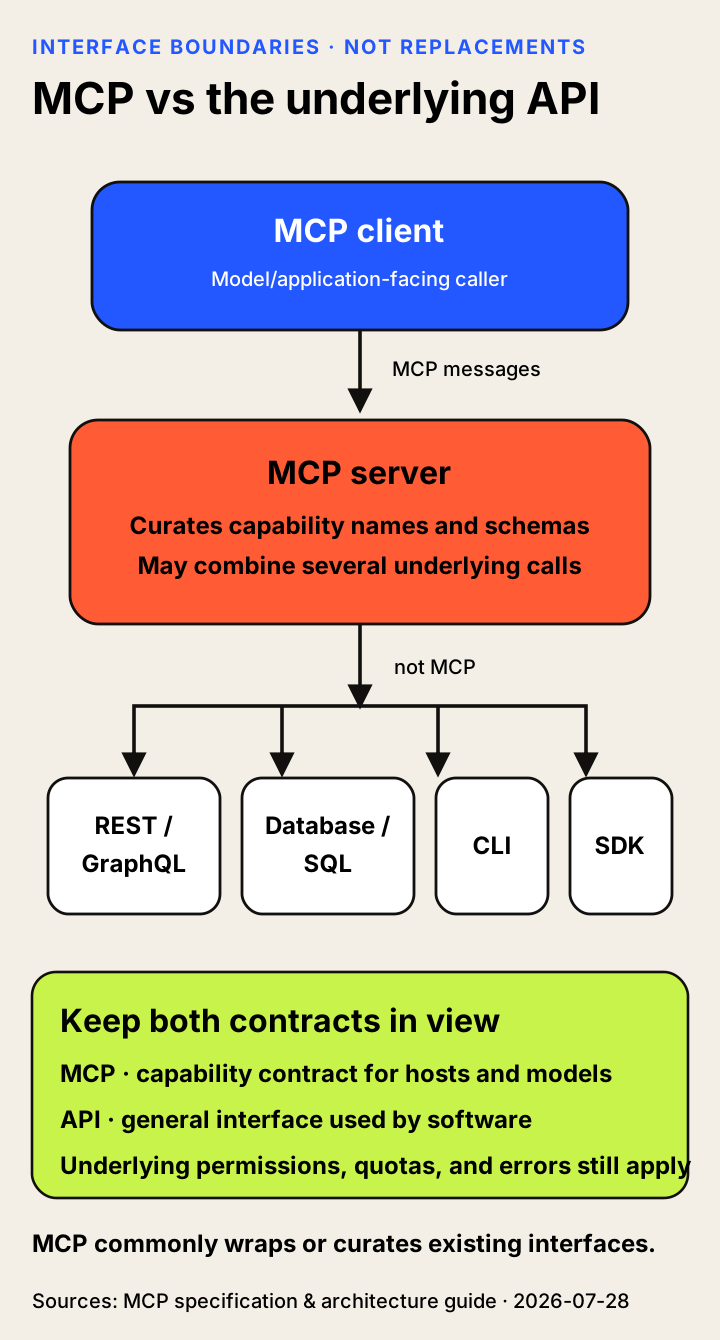
Those interfaces expose what a service can do. MCP standardizes how an AI host connects to a server that presents selected capabilities as model-usable tools and context. An MCP server will often call one or more ordinary APIs behind the scenes. For the neighboring model-facing layer, see MCP vs function calling.
The resulting stack looks like this:
AI application or agent → MCP client → MCP server → existing API, database, files, or business service
That is why replacing a well-designed API with MCP is usually the wrong goal. The useful question is whether an AI-facing interoperability layer would reduce repeated adapters across hosts. The original MCP launch announcement described the problem as fragmented integrations between AI assistants and data sources (S021); it did not declare general-purpose APIs obsolete.
The same customer lookup through REST and MCP
Suppose your application needs the status of customer 123. These are illustrative names, not a runnable integration or a particular vendor’s API.
| Step | Direct REST integration | MCP adapter over that REST API |
|---|---|---|
| Select the operation | Application code chooses GET /customers/123. | The host discovers a get_customer tool and its argument schema, then chooses whether to call it. |
| Send the request | The application’s HTTP client sends the API request. | The MCP client sends tools/call with tool name get_customer and argument customer_id: "123". The server validates it and calls the REST endpoint. |
| Apply access rules | The API checks whether the caller may read this customer. | The MCP server checks access to its tool; the API still checks access to the customer. A host approval does not override either check. |
| Return the result | Application code handles the API response. | The adapter returns a tool result the host can use. It must preserve a meaningful failure when access is denied or the customer cannot be found. |
Both paths can use the same backend. MCP adds a discoverable capability boundary; it does not supply customer data or remove API permissions. The tool specification defines tool listing, schemas, and invocation. A complete wire request also needs the metadata required by its protocol revision; the labels above are not complete JSON-RPC messages.
Choose the direct path for a fixed application workflow that already knows this endpoint. Consider the adapter when compatible AI hosts need to discover and use this capability. Neither design guarantees better accuracy, lower latency, or safer access: those depend on the implementation and its controls.
What a conventional API gives you
An API is a contract between software components. It can be public or private, local or remote, synchronous or event driven. Its design is normally optimized for a particular product domain: invoices, repositories, maps, identity, inventory, or payments.
A mature API may provide capabilities that MCP does not attempt to standardize:
- domain resources and operations with carefully designed semantics;
- bulk endpoints, filtering, pagination, webhooks, and event streams;
- idempotency keys, conditional updates, transactions, and concurrency controls;
- service-specific authentication, quotas, billing, and tenancy;
- long-lived compatibility guarantees and generated client SDKs; and
- operational tooling built around HTTP status, traces, schemas, and gateways.
APIs also serve many callers that have nothing to do with language models: mobile apps, back-office services, partner integrations, ETL jobs, and command-line tools. If a payroll service already has an authoritative API, its validation and business rules should remain authoritative when an MCP server is added.
“API” does not imply REST. MCP messages are based on JSON-RPC 2.0, which defines requests, responses, notifications, and errors (S001). Other APIs use the same RPC style, while still others use resource-oriented HTTP or generated binary contracts. The protocol family alone does not determine quality, safety, or fitness.
What MCP adds at the AI boundary
What about OpenAPI? OpenAPI describes HTTP APIs: their operations, inputs, responses, and other interface details. MCP defines an interaction protocol through which a host can discover and invoke exposed tools and access context. An OpenAPI description can inform an adapter, but it does not itself run an MCP server or decide which operations should become tools. Keep the API description and select the MCP surface deliberately.
MCP gives hosts and servers a shared vocabulary for capabilities that AI applications commonly need. Since the launch-era specification, servers have been able to expose callable tools (S028), URI-addressed resources (S029), and reusable prompts (S030). Tool schemas tell a host what arguments an operation accepts; structured output and output schemas later made results easier to validate (S045).
The current 2026-07-28 specification keeps the AI-facing contract while changing important lifecycle details (S054). The modern core is stateless: protocol version and client context travel with each request, and a client can use server/discover when it wants server capabilities in advance. List results can carry caching guidance; on Streamable HTTP, routing headers let ordinary infrastructure identify methods without parsing the JSON body. These are current behaviors; older tutorials built around a mandatory initialize handshake describe a previous revision (S055).
MCP also defines two standard deployment shapes. With stdio, the client launches a local server process. With Streamable HTTP, a server runs remotely behind an HTTP endpoint. The transport specification covers the different trust and operational boundaries (S057). A vendor API is typically remote; MCP can provide the same AI-facing interface for both a local developer tool and a hosted SaaS integration.
The benefit is reuse. A host that understands MCP does not need a bespoke plugin shape for every provider, and an MCP server can serve more than one compatible host. That reduces adapter work. It does not eliminate domain-specific engineering inside the server.
Side-by-side differences that matter
| Question | Conventional API | MCP |
|---|---|---|
| Primary audience | Any software client | AI hosts, clients, and agentic applications |
| Contract focus | Domain resources and operations | Discoverable tools and context for model-mediated use |
| Typical backend | Business logic is the API itself | Often adapts an API, SDK, database, or local capability |
| Discovery | Documentation, OpenAPI, GraphQL introspection, SDKs, or custom catalogs | Standard MCP discovery/list operations and schemas |
| Interaction | Application code selects a known endpoint or method | A host may let a model select among exposed capabilities |
| Transport | HTTP, messaging, gRPC, WebSocket, local calls, and more | Standard stdio and Streamable HTTP bindings |
| Authentication | Chosen by the API owner | Remote MCP defines an OAuth-based authorization profile; local process trust is separate |
| State | Entirely API-specific | Current core is stateless; applications can still manage explicit state |
| Optimization | Bulk workflows, webhooks, transactions, tight domain semantics | Cross-host interoperability and AI-oriented capability metadata |
| Main risk | Conventional integration and authorization failures | Those same risks plus model selection, tool metadata, and consent concerns |
The rows are tendencies, not hard walls. An API can expose machine-readable schemas, and an MCP client can call a single hard-coded tool without model choice. A remote MCP server still needs normal API engineering: authentication, authorization, rate limits, observability, stable errors, and version management.
Authorization illustrates the layering. MCP’s remote authorization model specifies how a client obtains a token intended for the MCP server (S044). If that server calls a CRM API, it needs authority appropriate to the CRM as a separate resource. Passing the MCP token straight through would erase the boundary. See the MCP security guide for the practical controls.
Three architectures that deliberately use both
Pattern 1: A thin adapter over a stable API
The MCP server translates a small set of high-value tools into calls to an existing API. It may turn find_customer into a REST query and create_support_case into a validated POST. Business validation remains in the service; the adapter adds concise tool descriptions, narrow schemas, result shaping, and user-friendly errors.
This is the best default when the API already exists. Keep the adapter thin enough that API clients and MCP clients receive consistent behavior.
Pattern 2: An AI-specific orchestration facade
One tool may coordinate several backend APIs because the model needs a goal-level operation rather than dozens of low-level calls. For example, prepare_account_review could fetch CRM history, open incidents, and billing status, then return a structured summary.
This can reduce latency, token use, and partial failure compared with letting a model improvise a long sequence. The facade should still make side effects explicit and should not hide an irreversible chain behind an innocent name.
Pattern 3: Local context plus remote systems
A developer host may use a local stdio server for repository files and a remote MCP server for issue tracking. The remote server in turn uses the issue tracker’s API. MCP gives the host one capability model across two deployment modes; the underlying access mechanisms remain different.
This pattern also shows why permission design cannot be copied blindly. Filesystem roots and subprocess privileges protect the local server. OAuth audiences and scopes protect the remote one.
Worked example: the same support-case task through an API and MCP
Suppose the authoritative service already creates support cases through an HTTP API. Deterministic application code can call that operation directly:
POST /v1/support-cases HTTP/1.1
Authorization: Bearer <service-token>
Content-Type: application/json
Idempotency-Key: case-2026-0912-001

{
  "customer_id": "cust_123",
  "summary": "Unable to export the August report",
  "severity": "normal"
}
An MCP server should not reimplement the case system. It can expose a narrower model-facing operation and translate it into that same API call:
{
  "jsonrpc": "2.0",
  "id": "req-42",
  "method": "tools/call",
  "params": {
    "name": "create_support_case",
    "arguments": {
      "customer_id": "cust_123",
      "summary": "Unable to export the August report",
      "severity": "normal"
    }
  }
}
The comparison becomes concrete when both paths share the same acceptance checks:
- The downstream service applies the same authentication, tenant, validation, and idempotency rules.
- The MCP server exposes only the fields the AI workflow needs and rejects unexpected arguments.
- The host shows the target customer and proposed side effect before the call when its policy requires confirmation.
- Both paths return the same stable case identifier and a useful error when the operation fails.
- Traces correlate the MCP request with the downstream API request without copying credentials or sensitive case text into broad logs.
Use the API path when code already knows that it must create a case. Use the MCP path when several compatible AI hosts need to discover and invoke the curated operation. This example is a contract pattern, not a claim that one adapter has been tested against every host or service.
When a direct API is the better choice
Choose the existing API directly when the caller and operation are known in advance and MCP would add no meaningful portability. Common examples include:
- a backend service posting a deterministic ledger entry;
- a mobile application fetching its own product screen data;
- a high-volume batch job using bulk and transactional endpoints;
- a webhook consumer responding to a documented event contract; or
- latency-sensitive code where another translation layer only adds cost.
A direct API is also clearer when you do not want a model choosing operations at runtime. Deterministic application code can still use an AI model elsewhere without converting every integration into a tool.
Add MCP when several compatible AI hosts need the same carefully bounded capability set, when local and remote context should share one client model, or when discoverable tools materially improve the user experience. Even then, expose purpose-built operations rather than mirroring hundreds of raw endpoints. A smaller, safer surface is easier for both humans and models to understand.
Choose the boundary before choosing the protocol
Start with ownership and semantics:
- Define the authoritative business operation and keep it behind a stable service boundary.
- Decide whether the caller is deterministic application code or an AI host that benefits from discoverable capabilities.
- If MCP is useful, expose the minimum tools and context needed for that AI workflow.
- Preserve separate authorization for the MCP server and every downstream resource.
- Measure the adapter’s latency, failure modes, model-call accuracy, and user approval quality.
MCP is most valuable as a standard edge around existing capabilities, not as a reason to rewrite them. APIs remain the foundation; MCP can make a selected part of that foundation portable across AI applications. For the next architectural boundary—delegating work to another autonomous system—compare MCP with A2A, and use the MCP architecture guide to map host, client, and server responsibilities.